









ORAL SWOT ANALYSIS
By the director of the postgraduate study programme - Kyriakos Kyriazopoulos
Preface
Ladies and gentlemen,
quality assurance in higher education has now evolved from a process of periodic evaluation into a comprehensive system of strategic management and continuous improvement. According to the Standards and Guidelines for Quality Assurance in the European Higher Education Area, quality is not exhausted by the recording of indicators or by formal compliance with institutional requirements. On the contrary, every Postgraduate Study Programme is required continuously to evaluate its identity, to reconsider its strategic objectives and to adapt to academic, social and professional developments.
Within this framework, SWOT analysis constitutes one of the most important instruments of strategic planning. It is not confined to the simple recording of strengths, weaknesses, opportunities and threats, but seeks to highlight the relationship between the internal and external environment of an organisation and to support its long-term academic planning.
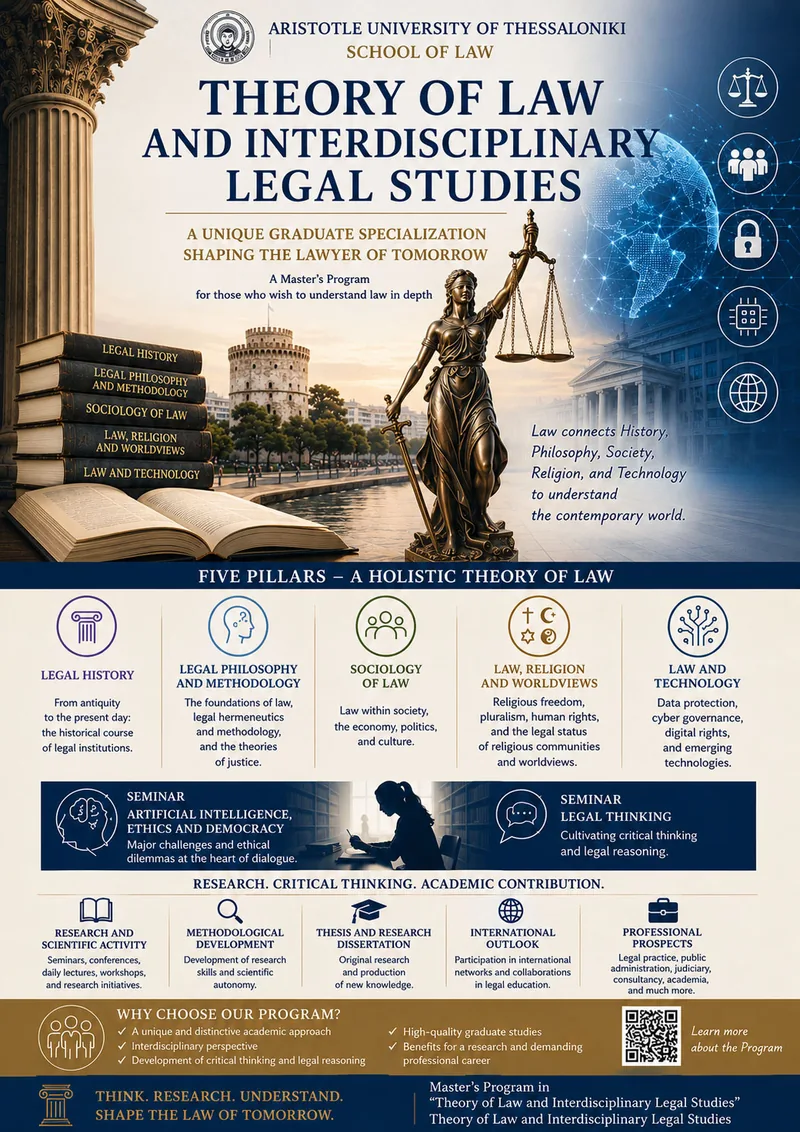
The present SWOT analysis is applied to the Postgraduate Study Programme “Theory of Law and Interdisciplinary Legal Studies” of the School of Law of the Aristotle University of Thessaloniki. It is a programme with a distinctive academic identity, since it combines the History of Law, the Philosophy and Methodology of Law, the Sociology of Law, Ecclesiastical Law (or Law of Religion and Worldviews) and Law and Informatics within a unified framework of theoretical and interdisciplinary legal studies, as reflected in its current Operating Regulations.
The evaluation that follows is not confined to the administrative operation of the Programme. It examines comprehensively its academic identity, its educational and research operation, the effectiveness of its quality assurance mechanisms and the prospects for its future development.
The study is based exclusively on documented primary material: the current Operating Regulations of the Postgraduate Study Programme, the evaluations of the teaching staff, the active postgraduate students and the graduates, as well as the theoretical study by the Director concerning the postgraduate specialisation, which provides the academic foundation for the identity of the Programme. The synthesis of these sources makes possible an evaluation based on documented data and not on fragmentary impressions.
The objective of the present presentation is to depict the strategic position of the Postgraduate Study Programme within the contemporary Greek and European area of postgraduate legal studies, through the systematic examination of the strengths, weaknesses, opportunities and threats that shape its future course.
CHAPTER I
The Methodology of the SWOT Analysis and Its Application to the Evaluation of the Postgraduate Study Programme
Turning now to the methodology, I would like to emphasise that the strategic evaluation of a Postgraduate Study Programme cannot be confined to numerical indicators or to the simple identification of positive and negative elements. Academic quality is multifactorial, since it encompasses institutional, academic, educational, research, administrative and social dimensions that interact with one another. For this reason, SWOT is used internationally as an instrument of strategic interpretation rather than as a simple method of recording data.
In the case of the Postgraduate Study Programme “Theory of Law and Interdisciplinary Legal Studies,” this approach is even more necessary. It is a programme with a pronounced theoretical and interdisciplinary identity, which cannot be assessed solely through quantitative indicators. Its academic identity, the composition of its fields of study, its research orientation, the quality of academic dialogue and the cultivation of critical legal thought require, above all, qualitative evaluation.
The present SWOT analysis is applied as a comprehensive process of strategic assessment. Each finding is examined in relation to the institutional framework of the Programme, the evaluations of the teaching staff, the active postgraduate students and the graduates, as well as the theoretical foundation of the postgraduate specialisation provided by the Postgraduate Study Programme.
The methodology is developed on three levels. First, the current Operating Regulations are examined, as they reflect the vision, identity, structure of the studies, learning outcomes and quality assurance procedures of the Programme. Second, the internal evaluations are utilised in order to determine the extent to which the institutional design is confirmed in practice. Particular importance is attached to the convergence of the views of the teaching staff, the students and the graduates, since this constitutes a strong indicator of the reliability of the conclusions. Third, the Programme's distinctive epistemological identity is also taken into account, because the evaluation of a Postgraduate Study Programme devoted to the Theory of Law and Interdisciplinary Legal Studies cannot be conducted according to the same criteria as those applied to programmes specialising in individual branches of positive law.
The SWOT analysis examines the Strengths, Weaknesses, Opportunities and Threats not as independent categories but as elements that interact with one another. A strong characteristic may create new opportunities, a weakness may reinforce an external threat, while an opportunity may be utilised only when the appropriate internal conditions exist.
At the same time, a distinction is drawn between the structural and the operational character of the Programme. The structural elements include the design of the studies, the selection procedures and the organisation of quality assurance. The operational elements include the quality of teaching, communication with the students, administrative support and participation in academic activities. This distinction allows for a more precise strategic evaluation.
Finally, the present SWOT analysis evaluates not only the current state of the Programme but also its future course. The identification of its strengths is intended to utilise them as the foundation for further development, while the identification of potential weaknesses serves to identify areas for continuous improvement. On the basis of this methodology, the four dimensions of the SWOT analysis will be examined successively, beginning with the Strengths of the Programme.
CHAPTER II
The Strengths of the Programme: Its Distinctive Academic Identity as a Strategic Comparative Advantage
Turning now to the Strengths of the Programme, the most significant finding is that its greatest comparative advantage does not lie in an individual organisational characteristic, but in its very academic identity.
Unlike most Greek postgraduate programmes, which are organised around a specific branch of positive law, the Postgraduate Study Programme “Theory of Law and Interdisciplinary Legal Studies” constitutes a unified field of study. The History of Law, the Philosophy and Methodology of Law, the Sociology of Law, Ecclesiastical Law (or Law of Religion and Worldviews), and Law and Informatics function as mutually complementary manifestations of the same academic inquiry rather than as isolated specialisations. It is precisely this combination that gives the Programme its distinctive academic identity.
This identity is not merely a theoretical choice reflected in the Operating Regulations. It is also confirmed by the evaluations of the teaching staff, the active postgraduate students and the graduates, all of which converge in recognising that the Postgraduate Study Programme does not simply provide specialised knowledge, but creates a fertile environment for academic dialogue, where different theoretical and interdisciplinary approaches coexist in a creative manner.
This finding is of particular importance because it corresponds to contemporary developments in international legal scholarship. Today, the production of new knowledge increasingly presupposes the integration of the history of institutions, the philosophy of law, the sociology of law, pluralism and multiculturalism, bioethics, digital governance, and artificial intelligence. This particular Postgraduate Study Programme has already been organised around precisely this theoretical axis and, consequently, occupies a particularly favourable strategic position.
A second important strength is the internal coherence of the curriculum. The individual fields of study do not operate in parallel and independently, but are connected through a common academic rationale. The History of Law interacts with Philosophy and Methodology, Sociology with theoretical analysis, Ecclesiastical Law with the relationship between law, society and religion, while Law and Informatics places digital developments within a broader normative and theoretical framework. In this way, a unified academic structure is created.
The quality of the teaching staff is also particularly significant. The experience, scholarly output and expertise of the faculty members make it possible to cover an exceptionally broad range of subjects without diminishing the quality of teaching. This picture is confirmed both by the active students and by the graduates, a fact that lends particular credibility to the conclusions of the evaluation.
At the same time, the Programme places emphasis on the development of academic thought. Through the five core courses, the two seminars on Artificial Intelligence, Ethics and Democracy and Legal Thought, the academic activities and the master's theses, critical analysis, theoretical synthesis and academic argumentation are cultivated, all of which are entirely consistent with the identity of the Theory of Law and Interdisciplinary Legal Studies.
Another major advantage is its organised research activity. The master's theses cover an exceptionally broad range of subjects, from legal history and the philosophy, methodology and sociology of law to religious human rights and the relations between the state and religions and worldviews, as well as artificial intelligence, the protection of personal data and bioethics. This diversity demonstrates that interdisciplinarity operates in practice and not merely at a theoretical level.
Finally, significant strengths include the clear Operating Regulations, the organised quality assurance policy, and the intensive academic activity carried out through seminars, conferences and academic events. All these elements create a coherent academic environment in which teaching, research, evaluation and continuous improvement operate in a mutually reinforcing manner. Thus, a positive cycle of academic development is established, constituting the most important strategic asset of the Postgraduate Study Programme and, at the same time, the basis for the examination of the internal challenges that follows.
CHAPTER III
The Weaknesses of the Programme: Internal Challenges and Areas for Further Strengthening
Turning now to the Weaknesses of the Programme, it is important to clarify that their identification does not constitute a negative evaluation. On the contrary, within contemporary quality assurance systems, recognising the areas that may be improved constitutes evidence of institutional maturity and organisational self-awareness. The analysis of the Operating Regulations, the evaluations and the postgraduate specialisation demonstrates that the Postgraduate Study Programme does not exhibit serious structural weaknesses. The issues that emerge are primarily operational challenges arising from the high level of its academic aspirations.
The first challenge is associated with its multidisciplinary identity. The coexistence of five different fields of study constitutes the Programme's greatest comparative advantage, but it requires continuous coordination, ongoing cooperation among the teaching staff, and the constant renewal of the common theoretical foundations that ensure its coherence. Although the evaluations do not indicate any problem of fragmentation, maintaining this unity remains a continuing strategic challenge.
A second aspect concerns the particularly high academic demands of the Programme. Its fields of study presuppose advanced theoretical thinking, research methodology and academic writing, while the applied interdisciplinary branches additionally require specialised methodological skills. This difficulty does not constitute a weakness in the Programme's design; on the contrary, it reflects its high academic standard. Nevertheless, it may be supported even more effectively through introductory activities in academic methodology and through the already established Seminar on Legal Thought.
The evaluations also highlight the increased workload. Systematic study, written assignments, participation in seminars and the preparation of the master's thesis create a particularly demanding environment, especially for employed students. The Operating Regulations already provide for the possibility of part-time study; however, the continuous increase in the number of employed postgraduate students makes the ongoing adaptation of educational practices necessary, without any compromise in quality.
Another issue concerns the visibility of the Programme itself. Its academic identity is exceptionally clear, but it requires familiarity with theoretical and interdisciplinary legal studies, a fact that may make it more difficult for a wider audience to understand it immediately. At the same time, there remains considerable scope for the further strengthening of internationalisation through additional international collaborations, English-language activities and the attraction of international students. Contributing in this direction is the new Seminar entitled “Artificial Intelligence, Ethics and Democracy,” which already strengthens the Programme's contemporary orientation.
It should be noted that, of the Master’s theses examined during the period 2020–2025, 80% achieved the objective of interdisciplinarity, while 20% did not.
Finally, the graduates emphasise the importance of an even closer alumni network, while the continuous development of the Postgraduate Study Programme increases the need for administrative support and the periodic updating of the curriculum in order to incorporate new academic developments in a timely manner.
Overall, however, these observations do not constitute substantial institutional or academic weaknesses. They relate primarily to the next phase of the Programme's strategic development: the further internationalisation of the Programme, the strengthening of its outward orientation, the effective utilisation of its alumni network, adaptation to technological developments, and the continuous support of its high academic standards. These findings naturally lead us to the next stage of the SWOT analysis, namely the opportunities created by the contemporary international academic environment.
CHAPTER IV
Opportunities: The New International Academic Environment and the Strategic Development Prospects of the Programme
Turning now to the Opportunities, the principal finding is that the most significant international developments in legal scholarship largely coincide with the identity of the Programme. These opportunities do not merely constitute favourable circumstances; they can be utilised only when a Postgraduate Study Programme possesses the appropriate academic foundation. This particular Programme appears to possess precisely these prerequisites.
The most significant development concerns the transformation of the very orientation of international legal scholarship. The development of artificial intelligence, the digital economy and biotechnology, together with the protection of human rights and the new challenges of democratic governance, has brought back to the forefront the theory of law, philosophy, methodology, legal history, the sociology of law, and the interdisciplinary fields of the law of religion and worldviews and digital law. In other words, international research is moving towards the very fields of study already cultivated by the Postgraduate Study Programme, a fact that gives it a significant strategic advantage.
The development of artificial intelligence is also of particular importance. Issues such as algorithmic decision-making, the liability of autonomous systems, the protection of personal data, algorithmic transparency and the ethics of artificial intelligence require profound theoretical and interdisciplinary analysis. The fact that the Programme has already incorporated these themes into both its teaching and research activities creates significant prospects for the years ahead.
At the same time, the internationalisation of higher education creates new opportunities for development. The increasing mobility of students and faculty members, international collaborations and European university networks favour programmes with a clear and distinctive academic identity. The Postgraduate Study Programme possesses precisely this identity, while the international presence of the Aristotle University of Thessaloniki creates a particularly favourable institutional environment for further international outreach.
Another significant opportunity arises from the increasing demand for scholars with theoretical training and interdisciplinary skills. The labour market, public institutions, international organisations and research bodies are now seeking legal professionals capable of analysing complex social and technological issues. At the same time, the development of lifelong learning is increasing the interest of professionals who seek deeper theoretical knowledge beyond the everyday application of the law.
Finally, the organised research output, the quality assurance procedures, the potential for the further development of English-language activities, and the effective utilisation of the alumni network create additional opportunities for international visibility and academic development.
Overall, the picture that emerges is particularly positive. The most significant international developments appear to strengthen, rather than restrict, the strategic course of the Programme. This, of course, does not mean that risks are absent. The increase in competition, demographic developments, changes in funding and the rapid pace of technological change create new challenges, which constitute the subject of the following chapter.
CHAPTER V
Threats: External Factors That May Influence the Future Development of the Programme
I now turn to the external threats, namely the factors that do not depend on the Programme itself but may influence its future development. Strategic management cannot eliminate these factors, but it can anticipate them and mitigate their impact.
The first challenge is the increasing competition among Greek and international postgraduate programmes. The distinctive theoretical and interdisciplinary identity of the Postgraduate Study Programme reduces this risk because it clearly differentiates it from most comparable programmes. Nevertheless, the continuous promotion of this uniqueness remains a strategic necessity.
A second threat is demographic decline, which may reduce the pool of prospective applicants. Internationalisation, English-language instruction and the attraction of international students constitute the principal responses to this development.
The rapid pace of technological change is also particularly critical. Artificial intelligence and large language models are transforming both the content and the methods of university education, making the continuous revision of educational material and research priorities essential.
Additional pressures arise from funding constraints, frequent institutional changes and the increasing emphasis on quantitative indicators, which do not always adequately reflect the contribution of the theoretical sciences.
Overall, however, most of these threats are common to European higher education as a whole, and several of them simultaneously become opportunities. Consequently, the external environment ultimately appears to be more favourable than adverse for this particular Postgraduate Study Programme.
CHAPTER VI
Overall Strategic Evaluation and Development Prospects of the Postgraduate Study Programme “Theory of Law and Interdisciplinary Legal Studies”
In concluding the SWOT analysis, the overall strategic assessment of the Programme is clearly positive. The Operating Regulations, the structure of the studies, the learning outcomes, the seminars, the research activities, the evaluation procedures and the supporting structures constitute a unified academic system with a clear mission: the development of high-level theoretical and interdisciplinary legal thought.
The convergence of the evaluations of the teaching staff, the active students and the graduates constitutes a strong indicator of quality. At the same time, the combination of the History of Law, the Philosophy and Methodology of Law, the Sociology of Law, Ecclesiastical Law (or Law of Religion and Worldviews) and Law and Informatics gives the Postgraduate Study Programme a clear and difficult-to-replicate academic identity.
The integration of teaching and research, compatibility with the European Standards and Guidelines for Quality Assurance, and the continuous updating of the Programme's content further strengthen its strategic position. The existing constraints are primarily external, while international developments in artificial intelligence, bioethics, democratic governance and the digital protection of rights create more opportunities than risks.
Accordingly, the Postgraduate Study Programme has reached a stage of institutional and academic maturity. Its strengths outweigh its weaknesses, its opportunities exceed its threats, and its existing structure provides a strong foundation for further development, international recognition and its establishment as a significant centre of theoretical and interdisciplinary legal studies.