




Theory of Law and Interdisciplinary Legal Studies – Postgraduate Specialisation
21 May 2026
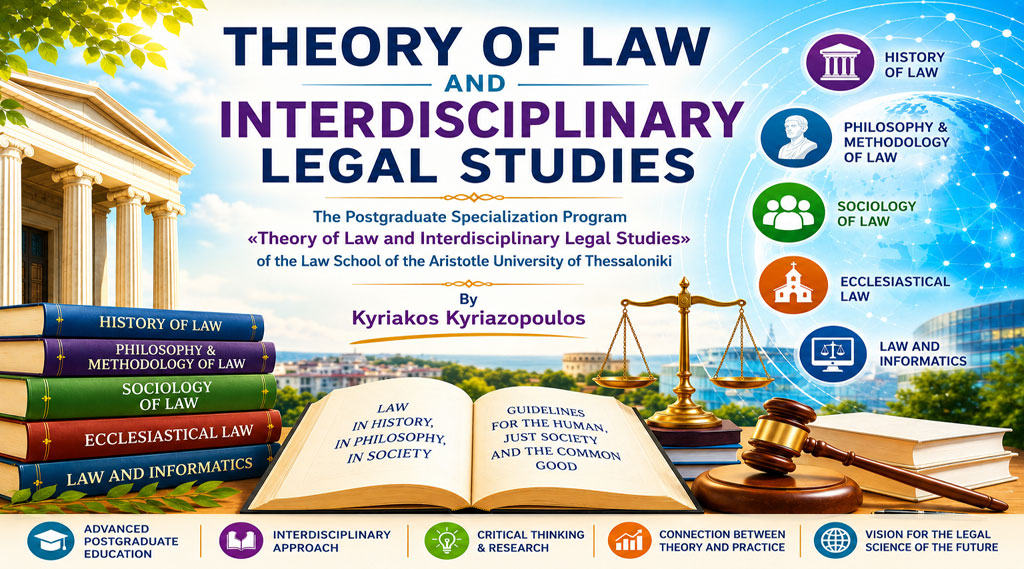
By Kyriakos Kyriazopoulos
The Postgraduate Specialisation Offered by the Postgraduate Study Programme "Theory of Law and Interdisciplinary Legal Studies" of the School of Law, Aristotle University of Thessaloniki
Preface
Contemporary legal science is undergoing a period of profound transformation. The social, political, technological, and cultural developments of recent decades have demonstrated that law can no longer be studied exclusively as an autonomous system of legal rules, nor can it be interpreted solely through the traditional doctrinal methods of legal scholarship. A proper understanding of the nature of law requires an examination of its historical origins, its philosophical foundations, its social functions, its relationship with religion and worldviews, as well as the new forms of regulation emerging within the digital society.
It is precisely from this epistemological realisation that the field of interdisciplinary legal studies has developed internationally. Interdisciplinary legal studies do not constitute an alternative form of legal science, nor do they seek to replace the doctrinal analysis of positive law. Rather, they aim to broaden the scope of legal scholarship, enrich its methodology, and enable legal scholars to understand law as a historical, social, cultural, and normative phenomenon.
The Postgraduate Study Programme "Theory of Law and Interdisciplinary Legal Studies" of the School of Law of the Aristotle University of Thessaloniki is firmly grounded in this contemporary academic perspective. According to its current Operating Regulations, the Programme is devoted to the advanced study of the academic field of Theory of Law and Interdisciplinary Legal Studies, which is structured around five interconnected fields of knowledge: History of Law, Philosophy and Methodology of Law, Sociology of Law, Ecclesiastical Law, and Law and Informatics. At the same time, the Regulations define the Programme's mission as the systematic advancement of specialised knowledge, the promotion of research, the cultivation of critical thinking, the exploration of the social and cultural dimensions of law, and the education of highly qualified scholars capable of pursuing successful academic and professional careers.
The purpose of the present monograph is to illuminate both the theoretical identity of this academic field and the distinctive form of postgraduate specialisation offered by this Programme.
CHAPTER I
Theory of Law as a Unified Academic Discipline
The concept of Theory of Law extends far beyond the traditional understanding according to which legal science is confined to the interpretation of positive legal rules. Theory of Law examines the fundamental conditions for the existence of law, the nature of normativity, the concept of the legal order, the forms through which law is created, the relationship between law and morality, the functioning of legal institutions, and the methodology of legal interpretation.
In this sense, Theory of Law does not constitute merely another branch of legal science but rather its general theoretical foundation. Just as the general theory of physics does not replace the individual branches of physics but explains the principles common to all of them, so Theory of Law seeks to identify and analyse the fundamental structures that underlie every branch of the legal order.
Theory of Law also functions as the discipline through which legal science reflects upon itself. It asks what is meant by a legal rule, what constitutes legal binding force, how judicial reasoning is justified, what the limits of legal interpretation are, and what role judges play in the development of law. These questions are not abstract philosophical exercises. On the contrary, they exert a direct influence upon the daily operation of courts, the legislative process, and legal reasoning.
For precisely this reason, contemporary Theory of Law has acquired a distinctly interdisciplinary character. The interpretation of legal phenomena requires the cooperation of history, philosophy, sociology, political science, economics, informatics, and the study of religion. Legal science does not thereby lose its autonomy; rather, it acquires a deeper understanding of its own subject matter.
Accordingly, the decision of the Postgraduate Study Programme to organise postgraduate education around five principal academic pillars is not merely an administrative classification of courses. It reflects a specific epistemological conception according to which Theory of Law is constituted through the synthesis of five major scholarly perspectives: the historical, the philosophical, the sociological, the ecclesiastical-legal, and the technological. This unity is expressed not only through the academic subject matter of the Programme but also through its objectives and intended learning outcomes, which seek to cultivate integrated scholarly thinking, promote original research, and establish meaningful connections between legal theory and social reality.
This unity constitutes the essential characteristic of the postgraduate specialisation offered by the Programme. It is not a specialisation in a narrow branch of positive law but rather a specialisation in the scientific understanding of law itself as a historical, philosophical, social, and institutional phenomenon.
CHAPTER II
Interdisciplinary Legal Studies as a Contemporary Academic Paradigm
The concept of interdisciplinary legal studies represents one of the most significant developments in contemporary legal scholarship. Throughout much of the twentieth century, legal research was organised primarily around the doctrinal analysis of positive law. This approach proved remarkably productive in the interpretation and systematisation of legal rules. Nevertheless, it was not always capable of providing satisfactory answers to more fundamental questions concerning the origins of legal institutions, the operation of legal norms within society, and the relationship of law with morality, religion, economics, technology, and culture.
The interdisciplinary approach emerged precisely in order to address this scholarly gap. It does not reject doctrinal legal analysis; rather, it complements it by recognising that every legal rule simultaneously constitutes a historical creation, a social institution, a cultural product, a philosophical construct, and a technological instrument for the organisation of social life.
Interdisciplinarity, therefore, does not signify the mere juxtaposition of knowledge derived from different academic disciplines. It denotes an integrated scholarly synthesis. History explains the origins of legal institutions. Philosophy interprets the concepts of justice, freedom, and equality. Sociology analyses the manner in which legal rules operate within society. Ecclesiastical Law examines the relationship between the State, religious freedom, and religious communities. Law and Informatics explores the new challenges generated by the digital society.
The Postgraduate Study Programme of the School of Law of the Aristotle University of Thessaloniki fully embraces this comprehensive approach. Its Operating Regulations do not treat the five academic fields as independent specialisations but rather as complementary dimensions of a single academic discipline: Theory of Law and Interdisciplinary Legal Studies. This choice reflects a contemporary epistemological perspective according to which the researcher is not narrowly specialised in a single branch of law but instead acquires a comprehensive theoretical foundation, enabling the examination of complex legal issues through multiple methodological perspectives.
This interdisciplinary educational philosophy is further reinforced by the Programme's objectives, which include the promotion of original research, the cultivation of critical thinking, the application of diverse scholarly methodologies, the integration of law with its social and cultural context, and the preparation of scholars capable of contributing both to academic research and to the formulation of public policy.
This approach fundamentally distinguishes the present Postgraduate Study Programme from programmes organised around a single branch of positive law. The specialisation offered does not focus exclusively on Civil Law, Public Law, or Criminal Law, but rather on the general theoretical foundations of legal science itself. In this way, the Programme establishes a unified field of advanced theoretical legal studies capable of supporting both future doctoral research and sophisticated scholarly engagement with every individual branch of legal science.
CHAPTER III
History of Law as the Foundation of the Legal Scholar's Theoretical Formation
The first major component of the Programme's academic field is History of Law. Its place within the Programme is by no means accidental. Historical knowledge constitutes an indispensable prerequisite for understanding every contemporary legal institution.
Law does not arise in a historical vacuum. Every legal order is the product of a long process of development through which institutions, legal concepts, and methods of interpretation are gradually shaped by social, political, and cultural transformations. A legal scholar who is unfamiliar with the historical evolution of legal institutions is confined to describing the law as it currently stands, without being able to comprehend the rationale that led to its formation.
History of Law provides precisely this perspective. It is not confined to the chronological recording of legislation or to the description of ancient legal institutions. Rather, its subject matter encompasses the historical evolution of legal concepts, the transformation of the sources of law, the development of judicial institutions, the historical evolution of legal interpretation, and the gradual emergence of legal science itself.
The current Operating Regulations of the Postgraduate Study Programme describe with particular clarity the educational objective of this academic field. Postgraduate students are expected to become familiar with the principal legal institutions of ancient Greece and Rome, to compare these two legal systems, and to evaluate their influence on contemporary legal thought. This educational approach is not intended to produce legal historians in the narrow sense of the term, but rather to cultivate historical consciousness as an indispensable element of the theoretical formation of every legal scholar.
The concise description of the courses contained in the Operating Regulations further reveals the Programme's theoretical orientation. Instruction is based upon the analysis of primary sources, including forensic speeches, inscriptions, papyri, historical writings, philosophical texts, and literary works. The study of these sources enables students to reconstruct not only legal rules themselves but also the broader social context within which those rules operated. Particular emphasis is placed upon the functioning of constitutional institutions, the administration of justice, the creation of law, commercial and transactional relations, family and succession law, as well as the earliest forms of legal interpretation.
This historical approach acquires particular significance within the broader framework of Theory of Law, since it enables students to understand the historicity of legal concepts themselves. Concepts such as property, contract, sovereignty, public authority, justice, and legal personality are not timeless and immutable categories. Rather, they acquire different meanings in different historical periods. Consequently, Theory of Law cannot be properly understood without continuous reference to the historical evolution of legal institutions.
History of Law therefore constitutes the first and indispensable foundation of the postgraduate specialisation offered by the Programme. It teaches the emerging scholar that the law in force at any given time always represents a single moment within a much broader historical continuum, and that a genuine scholarly understanding of the legal order requires historical perspective, comparative reasoning, and continuous engagement with the sources of legal civilisation.
CHAPTER IV
Philosophy and Methodology of Law as the Core of Theory of Law
If History of Law explains where legal institutions originate, Philosophy and Methodology of Law seeks to answer the deeper question of why these institutions exist, what constitutes their normative foundation, and how they may be interpreted in a rational manner. For this reason, the philosophy of law constitutes the core of every programme of theoretical legal studies.
Legal science is not confined to the description of the law in force. Every interpretation of a legal rule embodies a particular understanding of justice, the binding force of law, the relationship between the State and society, the role of the judge, and the limits of legal interpretation. These underlying assumptions are not always immediately apparent; nevertheless, they constitute the theoretical foundation of every legal judgment.
It is precisely these assumptions that the philosophy of law undertakes to analyse. It examines the nature of the legal order, the concept of the legal norm, the relationship between law and morality, the distinction between positive law and natural law, the concept of fundamental rights, and the ideas of equality, freedom, human dignity, and social justice. At the same time, it explores the principal schools of legal theory, ranging from legal positivism to institutionalism, interpretivism, pragmatism, and contemporary theories of human rights.
The methodology of law constitutes the second indispensable component of this theoretical framework. It is not sufficient merely to know what the legal rules are; one must also understand how they are to be interpreted. Legal interpretation is not an arbitrary intellectual exercise but is structured through established methods, principles, and rules of logical reasoning. Grammatical, systematic, teleological, and historical interpretation represent only part of legal methodology. Contemporary Theory of Law further encompasses the theory of legal argumentation, balancing theory, the theory of legal principles, the logic of judicial reasoning, and modern approaches to practical legal reasoning.
The Operating Regulations of the Postgraduate Study Programme reflect this dual mission with particular clarity. Among the intended learning outcomes, students are expected to acquire the ability to identify the fundamental principles of legal science, to apply legal reasoning and methodological approaches in formulating rational legal judgments, and to construct arguments in support of the protection of fundamental rights by integrating legal and philosophical conceptions of justice.
The course description further confirms its strongly theoretical orientation. Its subject matter includes law as a scientific discipline, the correctness of legal judgments, legal language, legal reasoning, the critical analysis of judicial decisions, the theoretical foundations of the protection of nature and the living world, the principles of justice, and the protection of fundamental rights. Accordingly, the course is not concerned with teaching individual legal rules but rather with educating students in the theoretical understanding of legal thought itself.
The importance of philosophical and methodological education becomes even greater within the contemporary legal order, where judges, legislators, and legal advisers are called upon on a daily basis to resolve conflicts between fundamental rights, address emerging technological developments, and interpret general clauses and indeterminate legal concepts. Such challenges cannot be met merely through the memorisation of legislation. They require theoretical sophistication, logical coherence, and methodological precision.
The postgraduate specialisation offered by the Programme in this field consists precisely in the cultivation of mature theoretical judgment. Graduates acquire far more than a knowledge of the philosophy of law; they develop the capacity to analyse, evaluate, and provide rigorous scholarly justification for their legal positions.
CHAPTER V
Sociology of Law and the Understanding of Law as a Social Institution
Theory of Law is not exhausted by either the historical or the philosophical approach. Law is neither merely a historical creation nor solely a system of logical rules. It is, at the same time, a social institution.
The Sociology of Law examines precisely this dimension. It investigates the manner in which legal rules emerge within society, influence social relations, and, at the same time, are themselves transformed by social developments.
The sociological perspective differs fundamentally from doctrinal legal analysis. The latter asks whether a legal rule is valid and how it should be interpreted. The Sociology of Law asks why a particular rule was created, which social interests it serves, how it operates in practice, what its actual effectiveness is, and what social changes it brings about.
Viewed from this perspective, it becomes evident that law constitutes a form of social organisation. It does not exist independently of society. The functioning of the courts, the administration of justice, compliance with legal rules, the social acceptance of legislation, and the evolution of legal institutions are all invariably dependent upon the broader social environment.
The Operating Regulations of the Postgraduate Study Programme attach particular importance to this scientific dimension. Among the intended learning outcomes, postgraduate students are expected to acquire the ability to understand the principal sociological theories, to explain law as a social phenomenon, and to evaluate its role in the management of social deviance and in the processes of globalisation.
Even more revealing is the description of the course content. The curriculum is not confined to general sociological theory but extends to issues such as negotiations, economic crises, globalisation, the relationship between law and economics, gender equality, social deviance, crime and punishment, law and culture, bioethics, organ transplantation, minorities, migration, the refugee issue, national ideology, and the State. This broad range of subject matter demonstrates that the Sociology of Law functions as a bridge between legal science and the major social challenges of the contemporary world.
The sociological dimension of Theory of Law is of particular importance for the scholarly formation of postgraduate students. Researchers learn not to regard law as a self-contained logical system but rather as a mechanism of social regulation that continuously interacts with the economy, politics, education, technology, culture, and evolving social values.
The contribution of the Sociology of Law to the postgraduate specialisation offered by the Programme is therefore of fundamental importance. It shapes legal scholars who are capable of connecting theoretical knowledge with the actual functioning of society and of approaching legal problems not only from a normative perspective but also from empirical and sociological viewpoints.
The completion of historical, philosophical, and sociological education already provides a comprehensive theoretical foundation. Nevertheless, the distinctive character of this particular Postgraduate Study Programme is revealed even more clearly through the final two pillars of its academic field—Ecclesiastical Law and Law and Informatics—which endow the Programme with its distinctive interdisciplinary completeness.
CHAPTER VI
Ecclesiastical Law (or the Law of Religion and Worldviews) as an Integral Component of Theory of Law
The distinctive character of the Postgraduate Study Programme is particularly evident in the inclusion of Ecclesiastical Law among the five principal pillars of its academic field. This choice does not merely preserve a historical academic tradition, nor is it confined to the study of the organisation of religious communities. Rather, it reflects the contemporary understanding that Theory of Law cannot be fully comprehended without examining the relationship between the legal order, freedom of religion, worldview pluralism, and cultural identity.
Today, Ecclesiastical Law constitutes a broader academic discipline that is increasingly described internationally as Law and Religion or even Law, Religion, and Worldviews. This development is not merely terminological. It reflects the transition from the traditional study of relations between the State and churches to a comprehensive examination of religious and worldview freedom within a pluralistic democratic society.
Within this framework, the discipline is not confined to the study of the Orthodox Church or of ecclesiastical institutions. Its subject matter encompasses the entire body of legal rules governing freedom of religion, the collective autonomy of religious communities, the equality of all religions and worldviews, the relationship between the State and organised forms of religious life, as well as the jurisprudence of national and international courts concerning freedom of conscience.
The incorporation of this academic field into Theory of Law is of particular significance because the relationship between law and religion constitutes one of the oldest domains in which the concepts of freedom, human dignity, tolerance, equality, and institutional autonomy were historically developed. Numerous fundamental legal concepts that are now regarded as self-evident within the constitutional rule of law have emerged through centuries of dialogue and conflict between secular and religious authority.
The theoretical study of this subject acquires even greater importance within today's multicultural society. Issues of religious freedom no longer concern exclusively the relationship between the State and traditional churches. They also encompass new religious communities, philosophical and humanistic worldviews, the protection of religious diversity, conflicts between freedom of expression and the protection of religious beliefs, as well as the development of neutral public institutions.
The Operating Regulations of the Postgraduate Study Programme clearly reflect this contemporary approach. Among the intended learning outcomes, students are expected to acquire the ability to describe the right to freedom of religion within the Greek and international legal orders, to apply the relevant legislation with particular reference to the case law of the European Court of Human Rights, and to formulate legal arguments concerning the regulation of relations between the State and religious communities through a comparative analysis of national and international legal frameworks. The Programme therefore provides not a narrow study of ecclesiastical institutions but rather a comprehensive theoretical and comparative education in the law of religious freedom.
The position of Ecclesiastical Law within the Postgraduate Study Programme thus acquires broader theoretical significance. It constitutes the field through which postgraduate students learn to approach questions concerning fundamental rights, constitutional theory, the international protection of human rights, and institutional pluralism, integrating these subjects into the broader framework of Theory of Law.
CHAPTER VII
Law and Informatics as a New Dimension of Theory of Law
The fifth pillar of the Programme's academic field demonstrates that Theory of Law is not exclusively concerned with the past or with the historical evolution of legal institutions. On the contrary, it is equally called upon to interpret the most contemporary phenomena arising from technological development.
Law and Informatics is not merely the application of information technology to legal practice. Rather, it constitutes a distinct academic discipline that examines the transformation of the legal order under the influence of digital technologies. The development of the Internet, electronic transactions, personal data protection, cybersecurity, digital evidence, electronic government services, and new forms of digital communication continuously gives rise to novel theoretical and practical challenges.
The significance of this academic field for Theory of Law is particularly profound. The digital age compels legal scholars to reconsider fundamental questions concerning the concepts of privacy, legal personality, consent, legal certainty, electronic evidence, liability, and the protection of fundamental rights. Traditional legal concepts are now required to operate within a technological environment that evolves at an exceptionally rapid pace.
The Operating Regulations of the Postgraduate Study Programme treat this academic field as an integral component of Theory of Law rather than as a purely technical subject. Among the intended learning outcomes, students are expected to acquire knowledge of the fundamental legal framework governing the protection of digital assets and personal data, to apply the law governing electronic transactions to practical cases, and to analyse the implications of data protection and fundamental rights in the online environment, including issues such as digital memory and the right to be forgotten.
This educational approach reveals a deeper theoretical conception. The law governing the digital society is not regarded as a fragmented technical discipline but rather as a field in which all the fundamental concepts of Theory of Law are re-examined. The concepts of legal personality, private life, freedom of expression, liability, legal protection, and State regulation acquire new meanings within the context of the digital environment.
It is precisely for this reason that the inclusion of Law and Informatics within the Postgraduate Study Programme does not merely represent the addition of another academic subject; rather, it completes the Programme's overall theoretical architecture. Through History of Law, students study the historical development of the legal order. Through Philosophy of Law, they examine its theoretical foundations. Through the Sociology of Law, they analyse its social function. Through Ecclesiastical Law, they explore its relationship with religious and worldview freedom. Through Law and Informatics, they interpret the new manifestations of the legal order within the digital world.
This structure clearly demonstrates that the Postgraduate Study Programme constitutes a coherent and integrated theoretical framework rather than a mere aggregation of five independent academic disciplines.
CHAPTER VIII
The Unity of the Five Academic Fields and the Formation of Contemporary Theory of Law
The inclusion of the five academic fields within the Postgraduate Study Programme should not be interpreted as the result of historical contingency or as an administrative decision intended merely to ensure the representation of different scholarly disciplines. Rather, it reflects a specific theoretical conception of the structure of legal science itself. The Programme is organised around the premise that Theory of Law is not simply another branch of legal science but the point at which all the major horizontal disciplines of legal scholarship converge.
History of Law provides the temporal dimension of law. Philosophy and Methodology of Law provide its logical and normative foundation. The Sociology of Law reveals its functioning within society. Ecclesiastical Law—or, in contemporary terminology, Law of Religion and Worldviews—examines the relationship between the legal order and religious and worldview pluralism. Law and Informatics studies the transition of the legal order into the digital age. Each of these academic fields illuminates a different dimension of the same phenomenon, namely law as a normative system for the organisation of social life.
This unity renders the Programme exceptionally coherent from an epistemological perspective. Postgraduate students do not move from one isolated academic field to another. Instead, they progressively construct a unified theoretical framework in which each discipline complements the others. Historical knowledge facilitates an understanding of the philosophical development of legal institutions. Philosophical analysis explains the sociological functions of law. The sociological perspective contributes to the understanding of issues concerning religious freedom and the digital society. Finally, the study of emerging technologies reintroduces all the classical questions of Theory of Law in new forms.
Interdisciplinarity thus acquires a substantive rather than merely descriptive meaning. It does not consist in the parallel teaching of five separate subjects but in their organic integration through common theoretical questions. The concepts of justice, equality, freedom, responsibility, institutional autonomy, interpretation, legality, and the protection of rights permeate all the Programme's academic fields, each of which approaches them from a distinct scholarly perspective.
It is precisely for this reason that Theory of Law functions as the discipline that integrates legal knowledge as a whole. A researcher who has acquired this theoretical foundation is able to move with greater ease across different branches of law, to employ historical, philosophical, sociological, and comparative arguments, and to address complex scholarly problems with methodological coherence.
This academic profile fully corresponds to the objectives set forth in the Programme's Operating Regulations. The advancement of knowledge and research, the development of original scholarly thought, the application of diverse scientific methodologies, the connection of law with social and cultural reality, the promotion of students' participation in research, and the preparation of highly qualified scholars all constitute different expressions of the same underlying academic philosophy.
CHAPTER IX
The Postgraduate Specialisation Offered by the Programme
One of the most important questions arising in any presentation of the Postgraduate Study Programme concerns the precise nature of the postgraduate specialisation that it provides. The answer to this question emerges directly from the Programme's own Operating Regulations.
The Programme is not organised into separate academic tracks, nor does it award different postgraduate degrees corresponding to individual academic fields. Instead, it awards a single Master of Science (M.Sc.) Degree entitled "Theory of Law and Interdisciplinary Legal Studies", while expressly providing that the Programme offers no specialisations.This regulatory provision is of considerable academic significance.
The absence of separate academic specialisations does not imply the absence of specialisation as such. On the contrary, it signifies that the specialisation is unified and encompasses the entire academic field of Theory of Law and Interdisciplinary Legal Studies. Graduates do not specialise exclusively in History of Law, Philosophy of Law, Sociology of Law, Ecclesiastical Law, or Law and Informatics. Rather, they specialise in the synthesis of all these scholarly disciplines into a coherent and integrated body of legal knowledge.
This approach fundamentally distinguishes the Programme from many postgraduate programmes organised around a single branch of positive law. The object of specialisation is not a particular area of legislation but the theoretical foundations of legal science itself.
From an academic perspective, this constitutes a postgraduate specialisation of a particularly advanced level. Students acquire sophisticated research skills, methodological competence, the ability to synthesise different scholarly approaches, and the capacity to produce original scientific knowledge. Such education prepares graduates to pursue doctoral studies, participate in research projects, teach theoretical disciplines within legal science, or apply their theoretical expertise in the practice of any legal profession.
The very structure of the curriculum reflects this academic philosophy. During the first and second semesters, students select four out of the five courses offered in each semester, while the third semester is devoted exclusively to the preparation of the Master's Thesis. In this way, an appropriate balance is achieved between structured academic instruction and original scholarly research.
The compulsory preparation of a Master's Thesis assumes particular importance within the context of this academic field. Theory of Law is, by its very nature, a research-oriented discipline. Genuine specialisation cannot be achieved solely through attendance at courses; it is completed primarily through the production of original scholarly research, in which students are required to apply, in an integrated manner, all the methodological skills they have acquired throughout their postgraduate studies.
The postgraduate specialisation offered by the Programme should therefore be understood as a unified specialisation in Theory of Law and Interdisciplinary Legal Studies, based upon the balanced integration of History of Law, Philosophy and Methodology of Law, Sociology of Law, Ecclesiastical Law (or Law of Religion and Worldviews), and Law and Informatics. This unity constitutes the Programme's defining characteristic and represents the essential feature that distinguishes it from every other model of postgraduate legal education.
CHAPTER X
The Contribution of the Postgraduate Study Programme to the Advancement of Scholarly Research, Legal Education, and Contemporary Legal Thought
The mission of a modern Postgraduate Study Programme is not exhausted by the transmission of specialised knowledge, nor is it confined to supplementing undergraduate education. At the postgraduate level, the principal objective shifts from the acquisition of knowledge to its production. The postgraduate student is no longer regarded merely as a recipient of scholarly information but as a researcher who is expected to participate actively in the creation of new scientific knowledge.
This conception permeates the entire philosophy of the Postgraduate Study Programme "Theory of Law and Interdisciplinary Legal Studies." From the very definition of its academic field and objectives, the Programme's Operating Regulations identify the advancement of knowledge and scholarly research as their foremost purpose. The systematic study of the principal currents of legal theory, the in-depth examination of the historical, philosophical, and sociological foundations of law, the promotion of original research through interdisciplinary methodologies, the cultivation of critical thinking, the participation of students in conferences, academic workshops, and scholarly publications, as well as the establishment of research groups, all constitute integral components of the Programme's academic operation.
This educational philosophy is of particular significance in view of the Programme's theoretical orientation. Theory of Law is, by its very nature, a research-oriented academic discipline. It is not satisfied with describing the law in force or repeating established doctrinal interpretations. Scientific progress is achieved through the formulation of new theoretical approaches, the critical re-examination of established doctrines, the application of innovative methodological tools, and continuous dialogue with the broader fields of the social sciences and the humanities.
This research-oriented dimension makes the Programme particularly well suited to serve as a preparatory stage for doctoral studies. Familiarity with primary sources, the development of methodological precision, the critical evaluation of scholarly literature, the synthesis of diverse academic approaches, and the preparation of an original Master's Thesis collectively provide the essential foundation for conducting doctoral research of the highest academic standard.
At the same time, the Programme's contribution extends well beyond the boundaries of the academic community. The theoretical formation it provides enables its graduates to address the complex challenges of the contemporary legal order with greater scholarly competence. The continuous emergence of new social, technological, and cultural developments requires legal scholars who are capable not merely of applying positive law but also of interpreting, evaluating, and theoretically reconceptualising legal institutions in light of evolving societal realities.
In this respect, the Programme makes a dual contribution to legal scholarship in Greece. On the one hand, it strengthens academic research by cultivating scholars capable of advancing theoretical legal inquiry. On the other hand, it educates a new generation of legal professionals able to bring rigorous theoretical reasoning into the everyday practice of the judiciary, public administration, legislative drafting, legal counselling, and the legal profession more generally.
Ultimately, the Programme contributes to the development of a legal culture in which theoretical reflection and practical application are no longer regarded as separate or competing domains but as complementary dimensions of legal science. By integrating historical understanding, philosophical and methodological analysis, sociological perspectives, religious and worldview pluralism, and an awareness of technological developments, the Programme prepares scholars capable of responding to the increasingly complex demands of contemporary legal systems, while at the same time contributing to the future development of legal thought itself.
CHAPTER XI
The Position of the Programme within the European and International Landscape of Theoretical Legal Studies
The internationalisation of higher education has made it essential to evaluate every postgraduate programme comparatively within the broader European and international academic environment. In this context, the Postgraduate Study Programme "Theory of Law and Interdisciplinary Legal Studies" possesses distinctive characteristics that render it fully compatible with the contemporary trends of international legal education.
First and foremost, the selection of Theory of Law as the Programme's central academic field corresponds to the international development of postgraduate programmes in Legal Theory, Legal Philosophy, Methodology of Law, Legal History, Socio-Legal Studies, Law and Religion or Belief, Law and Informatics, Jurisprudence, and Law and Society. Leading universities throughout Europe and North America increasingly offer comparable programmes that move beyond narrow doctrinal specialisation and approach law as a multifaceted academic phenomenon.
At the same time, the Programme's interdisciplinary organisation reflects the contemporary demands of scholarly research. History, philosophy, sociology, religion, and informatics are no longer regarded merely as auxiliary disciplines external to legal science; rather, they constitute integral components of contemporary Theory of Law.
This compatibility is further reinforced by the structure of the Programme itself. Its organisation into three academic semesters, the award of a total of ninety (90) ECTS credits, the emphasis placed upon the Master's Thesis, and the close integration of teaching and research fully accord with the principles of the European Higher Education Area and the Bologna Process.
Particular significance should also be attached to the Programme's international title, "Theory of Law and Interdisciplinary Legal Studies," which accurately reflects the nature of the postgraduate specialisation it offers and facilitates the academic recognition of the degree at the international level.
From a comparative perspective, the Programme's most distinctive characteristic lies in the fact that it is not confined to a single theoretical orientation. Theory of Law is approached through five distinct yet fully complementary academic disciplines, thereby endowing the Programme with both breadth and scholarly balance. This approach enables students to acquire a comprehensive theoretical education that may be applied equally in academic research and in professional legal practice.
It is precisely this integrative character that makes the Programme particularly relevant within the contemporary developments of international legal scholarship. The continuous interaction between law and technology, society, politics, culture, and human rights makes it essential to educate legal scholars capable of moving confidently across different academic disciplines without losing the coherence of legal methodology.
Accordingly, the Programme's international orientation is not confined merely to adopting European standards for the organisation of postgraduate studies. Rather, it is expressed primarily through its own academic identity, which incorporates the most significant developments in contemporary Theory of Law and Interdisciplinary Legal Studies.
CHAPTER XII
The Overall Character of the Postgraduate Specialisation Offered by the Postgraduate Study Programme
Following the analysis of the individual academic disciplines and their internal interrelationship, it is now possible to undertake an overall assessment of the postgraduate specialisation offered by the Postgraduate Study Programme "Theory of Law and Interdisciplinary Legal Studies" of the Faculty of Law of the Aristotle University of Thessaloniki.
The first conclusion to emerge is that the Programme is not organised around any particular branch of positive law. It is not designed to provide advanced specialisation in Civil Law, Criminal Law, Public Law, or International Law. Rather, its academic orientation operates at a different level altogether: the level of the theoretical foundations of legal science itself.
This educational choice is of particular epistemological significance. Legal science is invariably structured on two distinct levels. The first concerns the interpretation and application of positive legal rules. The second concerns the understanding of the concepts, methodologies, historical developments, social functions, and normative foundations that make the very existence of those legal rules possible. This Postgraduate Study Programme deliberately positions itself within the latter level.
The postgraduate specialisation it provides is therefore not a professional specialisation in the narrow sense of the term. Rather, it is an advanced academic and research-oriented specialisation which constitutes the foundation of professional specialisation and, in accordance with internationally recognised academic standards, transcends, analyses, and synthesises the various forms of professional legal specialisation. Its objective is not to produce specialists confined exclusively to a particular branch of legislation, but to educate scholars possessing profound theoretical formation and capable of approaching every legal issue with historical understanding, philosophical reflection, sociological awareness, comparative perspective, methodological precision, and a thorough appreciation of technological developments.
This philosophy is reflected in the very structure of the curriculum. The five academic disciplines are not presented as autonomous fields of specialisation but as equally important scholarly pillars of a single and unified academic field. The Programme's Operating Regulations are entirely explicit on this point. The subject matter of the Programme is the specialised cultivation of the academic field entitled "Theory of Law and Interdisciplinary Legal Studies," which comprises History of Law, Philosophy and Methodology of Law, Sociology of Law, Ecclesiastical Law, and Law and Informatics. Systematic academic advancement is therefore pursued across this academic field as a whole rather than within only one of its individual components.
From this perspective, the express provision contained in the Operating Regulations that "the Programme offers no specialisations" should not be regarded as a deficiency but rather as a deliberate scholarly choice. The postgraduate specialisation is not fragmented into separate academic tracks because the Programme's subject matter is, in essence, unified. Theory of Law cannot be divided into independent theories of history, philosophy, sociology, or religion. All these disciplines cooperate in fostering an integrated understanding of law as a complex social and normative phenomenon.
From an educational standpoint, this academic structure offers an additional and highly significant advantage. Graduates do not acquire narrowly confined knowledge linked exclusively to a particular professional field. Instead, they develop broad theoretical competence, enabling them to adapt to the continually evolving demands of legal scholarship, legislation, and judicial practice. Their theoretical education thus functions as a stable scholarly foundation, independent of the continuous transformation of positive law.
The significance of this educational philosophy becomes even more evident in the contemporary era, in which the traditional distinctions between the various branches of legal science have become increasingly fluid. Issues relating to technology, bioethics, the protection of personal data, freedom of religion, multiculturalism, globalisation, and European integration cannot be adequately addressed through a single doctrinal perspective. They require theoretical synthesis, methodological flexibility, and interdisciplinary thinking. It is precisely these intellectual capacities that this Postgraduate Study Programme seeks to cultivate.
Epilogue
Theory of Law as the Meeting Point of the Horizontal Legal Disciplines
Theory of Law has historically constituted the field within which legal science reflects upon its own nature. It is not confined to the interpretation of legal rules but examines the conditions underlying their existence, the methods governing their application, their social functions, their historical development, and the values they are intended to serve. For this reason, it constitutes the natural meeting point of all the horizontal disciplines of legal science.
The Postgraduate Study Programme of the Faculty of Law of the Aristotle University of Thessaloniki reflects this conception with remarkable consistency. The integration of History of Law, Philosophy and Methodology of Law, Sociology of Law, Ecclesiastical Law, and Law and Informatics forms a comprehensive theoretical approach to legal science that fully corresponds to the demands of contemporary academic research.
This educational philosophy assumes particular significance in light of the international evolution of legal scholarship. Contemporary societies require legal scholars who are not confined to the application of positive law but who possess historical consciousness, philosophical formation, sociological understanding, knowledge of religious and worldview diversity, and an awareness of the impact of digital technologies upon the legal order. The Programme responds precisely to these contemporary requirements.
At the same time, postgraduate education is not regarded merely as a continuation of undergraduate instruction but as the stage at which the emerging legal scholar enters the world of academic research. The cultivation of critical thinking, the development of scholarly methodology, participation in research activities, and the preparation of an original Master's Thesis constitute fundamental characteristics of the Programme and clearly demonstrate its research-oriented nature.
General Conclusions
The overall analysis of the Operating Regulations of the Postgraduate Study Programme permits the formulation of several clear academic conclusions.
First, the Programme's academic field is unified and is defined as "Theory of Law and Interdisciplinary Legal Studies," comprising five mutually complementary scholarly pillars: History of Law, Philosophy and Methodology of Law, Sociology of Law, Ecclesiastical Law—or, in contemporary terminology, Law of Religion and Worldviews—and Law and Informatics.
Secondly, the Programme is not organised into separate academic tracks and does not provide different specialisations corresponding to individual academic disciplines. Instead, it offers a single, advanced postgraduate specialisation in Theory of Law and Interdisciplinary Legal Studies, as is expressly provided in its Operating Regulations.
Thirdly, the postgraduate specialisation acquired by its graduates is primarily theoretical, research-oriented, and methodological in character. Its objective is to educate scholars capable of synthesising diverse academic approaches, producing original research, and contributing to the theoretical advancement of legal science.
Fourthly, the Programme's academic identity fully corresponds to the contemporary developments of international legal education, in which Theory of Law and Interdisciplinary Legal Studies have become major fields for the advancement of academic research and postgraduate education.
Finally, the Postgraduate Study Programme of the Faculty of Law of the Aristotle University of Thessaloniki emerges as a coherent and epistemologically integrated programme of theoretical legal studies, offering a unified, comprehensive, and academically advanced postgraduate specialisation in Theory of Law and Interdisciplinary Legal Studies, while preparing legal scholars capable of making substantial contributions both to academic research and to the theoretical and institutional development of the contemporary legal order.