



Comparison of university regulations on the use of artificial intelligence in research and academic writing in the West, Russia, and China
03 April 2026
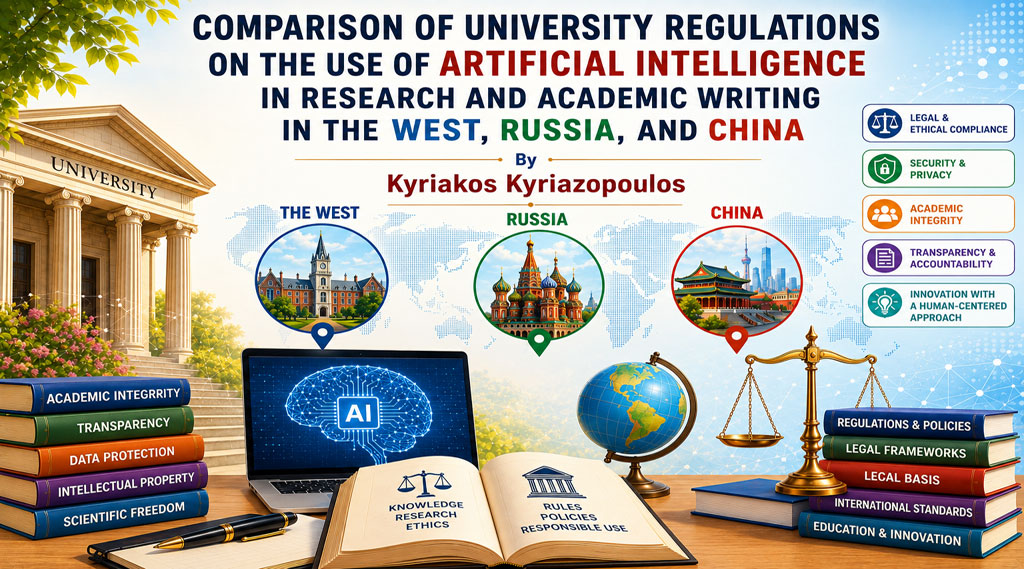
By Kyriakos Kyriazopoulos
"Comparison of university regulations on the use of artificial intelligence in research and academic writing in the West, Russia, and China"
CHAPTER I
The Emergence of Generative Artificial Intelligence in Higher Education
The emergence of Generative Artificial Intelligence in higher education constitutes one of the most profound transformations that the university has experienced since the digital revolution of the late twentieth century. The dissemination of large language models, such as ChatGPT, Gemini, Claude, and other generative artificial intelligence systems, did not merely bring about the introduction of yet another technological tool into the university process, but challenged the very manner in which the concept of knowledge, authorship, scientific authenticity, and academic work is constituted. For the first time in the history of higher education, systems appeared capable not only of searching for or organising information, but of producing continuous scientific text, synthesising arguments, developing summaries, creating bibliographical references, proposing research methodologies, and imitating to a great extent the form of human academic writing.
This transformation immediately caused a global crisis of regulatory adaptation among universities. The universities of the West, Russia, and China were confronted with the same technological phenomenon, but approached it through different cultural, political, and legal paradigms. In Western university traditions, the initial reaction was characterised by uncertainty as to the boundaries between permissible assistance and improper automation of academic work. In Russia, the discussion was connected more closely with informational sovereignty, cognitive security, and state control of digital knowledge. In China, by contrast, the development of Artificial Intelligence was treated as a strategic instrument of technological power and state-directed modernisation of higher education.
The crucial point is that Generative Artificial Intelligence is not confined to supporting the educational process, but directly affects the very core of academic production. Traditional university logic was based on the assumption that the writing of scientific text constitutes a direct manifestation of the personal intellectual work of the student or researcher. The emergence, however, of tools capable of producing complete scientific texts made the distinction between human creation and algorithmic production difficult. Thus, the problem of the use of Artificial Intelligence is not merely technical, but profoundly theoretical and regulatory.
The first major international institutional reaction came from UNESCO, which, already in 2023, issued the text “Guidance for Generative AI in Education and Research”. In that text, UNESCO emphasised that Generative Artificial Intelligence creates new risks for Academic Integrity, the reliability of knowledge, the protection of personal data, and the cognitive autonomy of learners, while at the same time it may offer significant possibilities for supporting learning and research. UNESCO adopted a clearly human-centred approach, considering that AI must function as an assisting tool and not as a substitute for human intellectual activity.
This approach strongly influenced Western universities, especially in the United States and the United Kingdom. A characteristic example is the Harvard University Information Technology – Generative AI Guidelines, where the use of Generative Artificial Intelligence is treated not as a universally prohibited practice but as a form of “responsible experimentation”. In these guidelines it is pointed out that the use of AI must comply with the principles of Academic Integrity, data protection, and transparency as to the use of these tools.
The same logic also appears in the guidelines of Harvard University for the use of ChatGPT and other generative AI tools, where it is emphasised that the university community is encouraged to experiment responsibly with the new tools, but without violating the principles of scientific integrity and the protection of confidential information.
Particular significance was acquired in the Western university environment by the concept of “instructor discretion”, that is, the authority of each instructor to determine independently the permissible limits of AI use in his or her courses. This model was shaped mainly in the United States and reflects the deeper philosophy of Western academic autonomy. Thus, instead of a single central regulation being imposed, many universities permitted instructors to adopt different policies: from complete prohibition to controlled or even broad acceptance of the use of AI. The Stanford Teaching Commons – AI Course Policies constitutes a characteristic example of this approach, providing model policies of different degrees of strictness.
This Western regulatory pluralism is directly connected with the historical tradition of academic freedom. The university of the West understands itself as a space of relative autonomy from the State, where the scientific judgment of instructors plays the primary role. Consequently, AI governance appeared mainly as a problem of internal university regulation and not as an object of direct state imposition.
By contrast, the Russian approach appeared more state-centred. In the Russian theory of digital sovereignty, Artificial Intelligence is not regarded merely as an educational tool but as part of the broader issue of the informational security of the State. The Russian discussion on AI in education was connected with fears of dependence on Western technological systems, weakening of human cognitive capacity, and erosion of national intellectual autonomy. For this reason, the Russian approach tends to be more centralised and less decentralised in comparison with American universities.
The Chinese approach followed a different direction. In China, Artificial Intelligence was treated from the outset as a strategic sector of national development. University policy was incorporated into the broader state programme of technological supremacy and digital transformation. The use of AI in research and writing was not treated primarily as a threat but as a necessary element of the technological modernisation of higher education. However, the Chinese acceptance of AI is accompanied by strong mechanisms of state supervision and disciplinary control of digital content.
Despite these differences, the common denominator of all systems was the recognition that Generative Artificial Intelligence fundamentally changes the concept of academic work. The issue is no longer confined to plagiarism in the traditional sense of copying another person’s text, but extends to the question whether a text produced algorithmically can be considered authentic academic work. This shift explains why most universities began to adopt disclosure obligations, that is, declarations of the use of AI in research and writing assignments.
Harvard Medical School, for example, emphasised that AI tools cannot be considered authors of scientific publications and that the entry of confidential research data into publicly available generative AI systems is prohibited. This position reflects the growing concern for the protection of research confidentiality, personal data, and intellectual property.
Thus, already from the first stages of the spread of Generative Artificial Intelligence, it became clear that universities are not merely facing a new technology, but a comprehensive restructuring of the relationship between human knowledge, scientific work, and digital automation. The comparison between the West, Russia, and China reveals that the different university policies on AI do not constitute isolated educational choices, but express deeper models of the relationship between State, knowledge, technology, and academic authority.
CHAPTER II
The Concept of Academic Integrity in the Age of AI
The emergence of Generative Artificial Intelligence did not merely cause technological disruption within the university environment, but called into question one of the fundamental regulatory principles of modern higher education: the principle of Academic Integrity. This concept, which was historically constituted as the foundation of the reliability of scientific knowledge and university assessment, was long based on the assumption that scientific work constitutes the product of the author’s personal intellectual processing. The use, however, of Artificial Intelligence systems capable of producing scientific text, organising arguments, and synthesising bibliographical presentations rendered unclear the traditional boundaries between personal creation, permissible assistance, and improper automation of scientific work.
Academic Integrity has never been exclusively a technical rule for the avoidance of plagiarism. It is connected more deeply with the institutional legitimation of the university as a space for the production of reliable knowledge. The reliability of degrees, scientific publications, doctoral dissertations, and university research more generally depends on the confidence that the work produced reflects real intellectual work by the subject who appears as its creator. Generative Artificial Intelligence introduces for the first time the possibility of mass production of apparently authentic academic discourse without corresponding human cognitive processing. It is precisely here that the regulatory crisis of contemporary university ethics is located.
This crisis manifested itself almost immediately after the public dissemination of ChatGPT at the end of 2022. Many universities were confronted with the problem of whether the use of generative AI constitutes a form of plagiarism, improper assistance, or a legitimate technological tool. The initial reaction of several institutions was prohibitive. However, the speed of dissemination and the practical impossibility of complete prohibition quickly led to a shift towards more complex forms of regulatory governance.
The most important change was the transition from the classical concept of plagiarism prohibition to a new concept of “responsible AI use”. The new regulatory standard does not focus exclusively on the prohibition of AI use, but on the obligation of its transparent, limited, and human-centredly controlled use. This change is clearly discernible in the guidelines of many leading Western universities.
The University of Oxford – Academic Integrity and Artificial Intelligence Tools emphasised that the use of AI tools is not prohibited in itself, but that every use must be clearly declared and must not substitute the student’s personal intellectual contribution. Oxford considers that Academic Integrity continues to require that the final work reflect the personal understanding, analysis, and judgment of the submitting person. (academic.admin.ox.ac.uk)
A similar position was also adopted by the University of Cambridge, which pointed out that the use of generative AI may be permitted only where there is clear acknowledgement of such use and no false impression of personal authorship is created. This approach reveals that the central core of Academic Integrity is now shifting from the simple prohibition of copying towards the safeguarding of transparency and authentic human contribution.
In the United States, this change was closely connected with the theory of faculty autonomy. Many universities avoided imposing uniform universal prohibitions and chose to allow instructors themselves to determine the permissible limits of AI use in their courses. The Stanford Teaching Commons – Creating Your Course Policy on AI provides different policy templates, from complete prohibition to controlled integration of AI into academic assignments.
This approach reflects a deeper Western regulatory conception according to which Academic Integrity is not safeguarded exclusively through central prohibition but through responsible self-regulation of the university community. The university continues to be treated as a community of scientific judgment and not as a strictly hierarchical state mechanism.
On the European continent, the discussion assumed a more intense ethical and regulatory character. The European conception of trustworthy AI significantly influenced university policies. The European standard does not focus only on the individual responsibility of the student but also on the institutional responsibility of universities to protect cognitive autonomy and the transparency of the scientific process. The influence of the European approach is already discernible in university policy documents that require disclosure, human oversight, and the possibility of verifying the human contribution to the final text.
UNESCO, in “Guidance for Generative AI in Education and Research”, stressed that Academic Integrity cannot be maintained if learners are transformed into passive consumers of algorithmically produced knowledge. UNESCO supports the view that AI use must remain under substantive human control and that the development of critical thinking cannot be replaced by automated content production.
In Russia, the concept of Academic Integrity was approached more through the prism of cognitive sovereignty and the protection of the intellectual self-sufficiency of the State. The Russian theoretical discussion on AI in education displays strong concern that dependence on large Western language models may lead to loss of national control over the production of knowledge. Consequently, Academic Integrity is treated not only as a matter of personal ethics but also as an element of informational and cultural security.
The Chinese approach is again differentiated. In China, the discussion on Academic Integrity is integrated into a broader system of state supervision of scientific production. The use of AI is permitted more broadly as a tool of technological modernisation, but is accompanied by strict mechanisms of disciplinary control. Chinese regulatory logic is not based so much on individual academic autonomy as on the maintenance of the institutional and state reliability of scientific production.
This transition ultimately leads to a deeper theoretical change in the concept of the author. The university of modernity was organised around the idea of individual intellectual creation. Generative Artificial Intelligence, however, introduces forms of hybrid authorship, where the final text results from interaction between human and algorithm. Thus, the problem of Academic Integrity is gradually transformed into a problem of determining the minimum necessary level of human cognitive participation required for a text to be considered authentically university work.
This change explains why most contemporary university systems no longer move towards universal prohibitions, but towards complex regulatory models of disclosure, human supervision, and responsible AI use. The new Academic Integrity is no longer based exclusively on the absence of external assistance, but on the transparent and controlled relationship between human intellectual work and algorithmic assistance.
CHAPTER III
The Western University Approach and the Model of Responsible AI Use
The Western university approach to Generative Artificial Intelligence was shaped under conditions of unprecedented speed of technological change and regulatory uncertainty. The public dissemination of ChatGPT at the end of 2022 created a situation that most universities in the United States and Europe had not anticipated. The already existing rules on plagiarism, academic fraud, and permissible academic assistance proved insufficient to address systems capable of producing continuous scientific text, simulating analytical thought, and synthesising persuasive academic discourse. The result was the rapid development of a new regulatory model, which gradually prevailed in Western universities and may be characterised as the model of “responsible AI use”.
This model is based neither on the absolute prohibition of Artificial Intelligence nor on its unconditional acceptance. On the contrary, it seeks to integrate the use of AI into the university process under conditions of transparency, human oversight, and preservation of the substantive cognitive contribution of the student or researcher. Western regulatory logic recognises that complete prohibition is practically unenforceable, while at the same time considering that the uncontrolled use of generative AI would lead to the weakening of academic credibility and of the pedagogical function of the university.
The first phase of the Western reaction was characterised by fragmentary and often contradictory policies. Many universities adopted temporary prohibitions on the use of ChatGPT in written assignments, while others permitted limited use under conditions. However, already within 2023, a more coherent model was gradually formed, based on four principal axes: the obligation of disclosure, the requirement of substantive human oversight, the preservation of the academic responsibility of the author, and the authority of instructors to determine specific rules on AI use.
The concept of disclosure quickly became central. Most Western universities judged that the basic problem is not necessarily the use of AI itself but its non-transparent use. This logic is reflected in the guidelines of the University of Oxford, where it is stated that students must clearly declare when and in what manner they used generative AI tools in the writing of assignments. The university considers that non-disclosure of AI use may constitute a form of academic misrepresentation, even if the produced text does not constitute classical plagiarism.
The same conception also appears in the policies of Harvard University. Harvard did not adopt a universal prohibition on the use of generative AI but emphasised that the use of such tools must take place responsibly, with respect for Academic Integrity, data protection, and transparency. The guidelines of Harvard University Information Technology expressly state that members of the university community remain responsible for the accuracy, reliability, and ethical use of the content produced even when AI tools are used.
Gradually, the Western approach began to abandon the traditional logic of “absence of assistance”, that is, the complete absence of external help during writing, and to adopt a new logic of “human-centered oversight”. According to this logic, the use of AI may be considered permissible provided that the substantive cognitive processing, critical evaluation, and final scientific responsibility remain with the human author. This shift is directly connected with the deeper philosophy of the Western liberal university, which historically treats technology as a tool for strengthening individual creativity and not exclusively as a threat to be prohibited.
Particular significance was acquired in the American university environment by the concept of “instructor discretion”. Instead of strict uniform regulations being imposed, many universities chose to allow the instructors themselves to determine the limits of permissible AI use in their courses. Stanford University, through the “Stanford Teaching Commons”, provides different policy models, from complete prohibition of AI use to limited or even extensive integration of generative AI into academic assignments.
This approach reveals a deeper structural particularity of the Western university tradition: the emphasis on the decentralisation of academic authority. The regulatory governance of AI is not considered the exclusive task of the State or of the central administration of the university, but the object of the specific scientific judgment of faculty members. Thus, the issue of AI governance is incorporated into the logic of academic autonomy.
At the same time, Western universities began to develop policies concerning the protection of personal data and confidential information. The use of public generative AI systems created fears that students and researchers might enter into such systems unpublished research data, medical information, personal data, or confidential university material. Harvard Medical School expressly warned that the entry of sensitive data into publicly available AI tools is not permitted, because this may violate both research ethics and data protection law.
In Europe, the regulatory discussion was more strongly influenced by the broader European theory of trustworthy AI and human-centered AI governance. The European approach is not confined to the functional use of AI but seeks to ensure that technology remains compatible with the fundamental values of human dignity, transparency, and democratic accountability. This influence is evident in university policies that require not only disclosure but also the possibility of verifying the human contribution to the final academic work.
UNESCO played an important role in shaping this framework. In “Guidance for Generative AI in Education and Research” it is maintained that AI may be used creatively in education and research, but only on the condition that the development of critical thinking and human cognitive autonomy is not undermined. UNESCO considers that education must not be transformed into a process of passive consumption of algorithmically produced knowledge, but must remain a space for the development of independent scientific judgment. (unesco.org)
The Western approach is also characterised by strong concern about the phenomenon of hallucinations, that is, the production of false or non-existent information by generative AI systems. This concern acquired particular significance in scientific research, where the use of AI for bibliographical documentation or legal analysis may lead to fabricated citations and false references. For this reason, many universities emphasise that the researcher remains fully responsible for verifying the accuracy of every piece of information produced through AI.
The new Western regulatory logic no longer treats academic work as fully isolated from technology. On the contrary, it recognises that the use of AI tools will likely become a permanent element of scientific and professional reality. Consequently, the mission of the university shifts: it is no longer simply to prohibit or permit the use of AI, but to educate students in its responsible, transparent, and critical use.
This change marks a deeper transformation of the Western university paradigm itself. Academic Integrity ceases to be defined exclusively as the absence of external assistance and is transformed into a system of transparent management of the relationship between human cognitive activity and algorithmic assistance. Through this shift, a new university model emerges, in which Artificial Intelligence is treated neither as an absolute enemy nor as an autonomous substitute for human science, but as a tool that requires continuous regulatory and ethical control.
CHAPTER IV
The American Logic of Instructor Discretion and Syllabus Governance
The American university approach to Generative Artificial Intelligence differs markedly not only from the more state-centred models of Russia and China but also from several European forms of regulatory governance. Its basic particularity lies in the fact that the regulatory management of AI use was organised primarily around the concept of the academic autonomy of the instructor and not through universal central prohibitions. The concept of “instructor discretion”, that is, the discretionary authority of each instructor to determine the limits of permissible use of Artificial Intelligence in his or her courses, became the core of American AI governance in higher education.
This choice was neither accidental nor exclusively technical. It reflects deeper historical and institutional traditions of the American university. American higher education developed within a system of strong decentralisation, where academic authority is distributed among departments, faculties, and individual instructors, while state intervention remains comparatively limited. Consequently, the emergence of Generative Artificial Intelligence was not treated primarily as a problem requiring a uniform state regulation but as a pedagogical and academic issue that had to be resolved within the university community itself.
This logic is clearly discernible in the guidelines of Stanford University through the “Stanford Teaching Commons”. Stanford did not impose a uniform prohibitive policy but provided instructors with model syllabus statements concerning AI use. These guidelines include different versions of policy: complete prohibition of AI use, limited use only for specific assignments, or even encouragement of creative use of generative AI under conditions of transparency and acknowledgement of its use.
The crucial element is that the American approach transfers the centre of gravity from the central university regulation to syllabus governance. The syllabus, that is, the official framework of rules for each course, is transformed into the primary regulatory instrument of AI governance. The instructor is called upon to determine clearly which use of AI is permitted, which is prohibited, which forms of disclosure are required, and which are considered a violation of Academic Integrity.
This shift has profound theoretical consequences. In the American tradition, academic freedom concerns not only freedom of research and teaching but also the ability of the instructor to determine the methodology of assessment and the conditions for the production of academic work. AI governance is therefore incorporated into the core of faculty governance and not exclusively into the administrative hierarchy of the university
The Massachusetts Institute of Technology followed a similar approach. MIT emphasised that AI use must be treated as a new form of digital literacy and not exclusively as a problem of academic fraud. MIT policies encourage instructors to redesign assessment methods so as to incorporate or take into account the possibility of the use of generative AI by students. This logic shows that the American university does not simply seek to control technology but to reform the pedagogical structures themselves in light of the new technological reality.
The concept of syllabus governance is also connected with the legal culture of the United States. The syllabus functions not only as a pedagogical document but also as a particular kind of regulatory agreement between instructor and student. The rules on AI use included in the syllabus are considered part of the student’s obligations within the framework of the specific course. Thus, violation of AI rules may be treated as a form of academic misconduct even where there is no uniform university regulation.
The University of Michigan, through the “Generative AI Guidelines”, urges instructors to formulate with absolute clarity what is permitted and what is prohibited with regard to AI use. The university recognises that ambiguity creates risks both for Academic Integrity and for the fair assessment of students. The need for clarity reveals precisely that AI governance is not considered exclusively a technological issue but a regulatory relationship of trust between instructor and student.
At the same time, the American approach is characterised by strong pragmatism. Many universities recognised that a complete prohibition of AI use is practically impossible. The ease of access to generative AI systems, the difficulty of detection, and the extremely rapid incorporation of these tools into everyday professional life rendered the attempt to exclude them completely from the university process unrealistic. Consequently, American AI governance gradually became oriented not towards the elimination but towards the management of AI use.
This approach also led to a change in forms of assessment. Many American universities began to strengthen forms of oral assessment, in-class writing, iterative drafting, and project-based evaluation, through which it becomes easier to ascertain the student’s real cognitive participation. Artificial Intelligence thus functions as a catalyst of a broader pedagogical transformation.
These terms are now used very frequently in university policy documents for addressing the use of generative AI and denote alternative forms of assessment that make excessive dependence on Artificial Intelligence more difficult or more controllable.
The oral assessment means “oral evaluation”. It is an examination or assessment through oral discussion, interview, viva, oral defence, or academic dialogue between instructor and student. This method is used increasingly because it allows the instructor to ascertain whether the student truly understands the content that he or she submitted in writing. Within the framework of AI governance, oral assessment functions as a mechanism for verifying the authentic cognitive participation of the student. For example, a student may have submitted an excellently structured paper using AI, but in an oral examination it may be shown that he or she does not understand even the basic argumentation of the text.
The in-class writing means “writing within the classroom” or “on-site written assignment”. It is the production of written text during the course, under physical supervision, without or with limited access to external digital tools. This practice is dynamically returning to many universities because of the difficulty of distinguishing human text from AI-generated text in take-home assignments. Through in-class writing the instructor can compare the student’s natural style, linguistic ability, and mode of thinking with subsequent assignments submitted digitally.
The iterative drafting means “successive development of drafts” or “gradual writing development through multiple drafts”. Instead of submitting only the final text, the student is obliged to submit successive versions of the assignment: initial plan, bibliographical outline, draft chapters, intermediate revisions, final form, and so forth. This method allows the supervisor to follow the gradual development of the student’s thought and writing. In the age of AI, iterative drafting is considered an important mechanism for protecting Academic Integrity, because it makes the complete replacement of personal writing by algorithmic text production more difficult.
The project-based evaluation means “assessment through a project”. Instead of assessment being based exclusively on examinations or standardised assignments, the student is assessed through a complex project that requires research, presentation, collaboration, application of knowledge, and often public defence of the results. This method is considered more resistant to the misuse of AI, because the project usually includes processes that cannot easily be fully automated, such as practical application, oral presentation, research documentation, and continuous interaction with the instructor.
All four methods form part of a broader transformation of university assessment in the age of Generative Artificial Intelligence. Universities are gradually moving away from the traditional model of the simple final written assignment towards more complex forms of assessment that allow the verification of the student’s real cognitive participation and of the authenticity of his or her scientific work.
Particular significance was also acquired by the discussion concerning AI literacy. The American university gradually began to regard knowledge of how to use AI not merely as a threat but as an essential professional competence. Many institutions now consider that university education ought to teach students how to use generative AI tools critically, responsibly, and effectively. Consequently, AI governance also acquires a positive dimension: it is not confined to preventing misuse but also encompasses the cultivation of new forms of digital and cognitive literacy.
Nevertheless, the American approach is not without its internal contradictions. Excessive decentralisation frequently creates regulatory diversity and uncertainty. Different instructors may apply radically different rules within the same university, thereby creating problems of consistency and equality of treatment among students. Furthermore, reliance upon syllabus governance presupposes a high level of institutional maturity and individual responsibility on the part of both instructors and students.
Ultimately, the American logic of instructor discretion reveals a deeper philosophical conception of the university. The university is not regarded as a strictly hierarchical mechanism for producing compliance but as a dynamic community of scholarly judgment, in which regulatory responses to technological change should emerge through decentralised academic self-regulation. Artificial Intelligence is viewed not only as a threat to Academic Integrity but also as an opportunity to redefine the pedagogical function of the university itself.
Accordingly, American AI governance does not merely constitute a body of technical rules governing the use of new technological tools. Rather, it reflects a comprehensive theory of academic autonomy, decentralised authority, and adaptive pedagogy, which differs fundamentally both from the more state-centred systems of Russia and China and from certain more institutionally centralised European approaches.
CHAPTER V
European Ethical AI Governance and the Influence of the European Regulatory Framework
The European approach to the use of Artificial Intelligence in higher education differs substantially both from the American model of decentralised instructor discretion and from the more state-centred models of Russia and China. Its distinctive characteristic lies in the fact that Artificial Intelligence is regarded primarily as an issue of regulatory and ethical governance, intrinsically linked to the protection of Fundamental Rights, human dignity, transparency, and democratic accountability. European AI governance is therefore not confined to the functional regulation of the use of new technological tools but forms part of a broader theoretical and political project of "human-centred" technological governance.
The fundamental theoretical premise of the European approach is that Artificial Intelligence cannot be regarded exclusively as a neutral technological innovation. On the contrary, AI is considered to exert a structural influence upon power relations, the distribution of knowledge, the functioning of institutions, and the exercise of Fundamental Rights. Consequently, its use in education and research must be subject to enhanced guarantees of transparency, accountability, and human oversight.
This orientation had already begun to emerge before the rapid expansion of Generative Artificial Intelligence systems. The European Commission, through the Ethics Guidelines for Trustworthy AI issued by the High-Level Expert Group on Artificial Intelligence, maintained that trustworthy Artificial Intelligence should be founded upon seven fundamental principles: human agency and oversight, technical robustness and safety, privacy and data governance, transparency, diversity, non-discrimination and fairness, societal and environmental well-being, and accountability.
These principles profoundly influenced European universities. Unlike many American institutions, which focused primarily on the operational management of AI use, European universities approached the issue through the perspective of ethical governance. The use of Generative Artificial Intelligence was regarded not merely as a matter of Academic Integrity but also as a question of the institutional responsibility of the university as a producer and guardian of democratic knowledge.
This influence is evident in the policies adopted by numerous European universities. The University of Edinburgh, for example, emphasised that the use of Generative Artificial Intelligence must comply not only with the requirements of Academic Integrity but also with the principles of fairness, transparency, and accountability. The University recognises that AI may create risks of misinformation, the reproduction of bias, and the erosion of critical thinking and therefore requires its responsible and supervised use.
The European regulatory approach was strengthened even further through the development of the European legal framework governing Artificial Intelligence. The European Union, through the AI Act, established the world's first comprehensive supranational regulatory framework for Artificial Intelligence. Although the AI Act does not apply exclusively to universities, it directly influences the manner in which European higher education institutions conceptualise AI governance. The fundamental philosophy of the AI Act is risk-based: AI systems are classified according to the level of risk they pose to Fundamental Rights and to the social functioning of institutions.
The influence of this logic upon higher education is particularly significant. European universities are increasingly beginning to regard the use of Artificial Intelligence not merely as an individual choice of the student or researcher, but as an area of institutional risk management. The reliability of scientific knowledge, the protection of students' personal data, the prevention of discrimination, and the preservation of human cognitive autonomy are treated as institutional obligations of the university itself.
The European approach also places particular emphasis on the protection of personal data. The connection between Generative Artificial Intelligence and the European Data Protection Board is direct, since many AI systems process large quantities of personal or research data. Universities are therefore required to examine whether the use of publicly available AI tools is compatible with the General Data Protection Regulation (GDPR). This concern is particularly pronounced in universities handling medical, biotechnological, or other sensitive social data.
European AI governance is likewise characterised by greater emphasis on institutional responsibility and less reliance upon the exclusive individual judgment of the instructor. Although a degree of decentralisation also exists in Europe, universities more frequently tend to issue central institutional guidelines. The University of Cambridge, for example, has issued unified guidelines requiring disclosure of AI use, a clear distinction between human-generated and algorithmically generated content, and compliance with the principles of Academic Integrity.
The European approach is also connected with a deeper theoretical concern regarding cognitive autonomy. Numerous European policy documents express concern that excessive dependence upon Generative Artificial Intelligence may weaken the development of critical thinking, analytical ability, and original scientific creativity. Education is regarded not merely as a process of producing functional professional skills, but as a process of cultivating autonomous cognitive subjects.
UNESCO has exerted a particularly significant influence upon this discussion. In its Guidance for Generative AI in Education and Research, it emphasises that Artificial Intelligence must not replace the learning process or transform students into passive consumers of algorithmically generated knowledge. UNESCO maintains that human critical thinking and cognitive autonomy constitute irreplaceable elements of the educational process.
At the same time, the European debate has devoted considerable attention to the issues of explainability and transparency of AI systems. The academic community is concerned that students and researchers are increasingly using systems whose operation remains largely opaque. Such opacity is regarded as problematic not only from a technical perspective but also from an epistemological one, since it impedes the verification of the process through which knowledge is generated.
European AI governance is therefore characterised by a distinctive synthesis of regulation, ethics, and political theory. The use of Artificial Intelligence in higher education is regarded as an issue affecting the democratic functioning of knowledge, the protection of human dignity, and the institutional credibility of the university. In contrast to the American model, which relies more heavily upon academic self-regulation and instructor discretion, the European approach demonstrates a stronger tendency towards institutional and regulatory harmonisation.
Ultimately, European ethical AI governance does not merely seek to limit the misuse of Artificial Intelligence. It seeks to integrate AI into a comprehensive human-centred model of technological governance, in which innovation remains subordinate to the principles of democracy, transparency, human oversight, and the protection of cognitive autonomy.
CHAPTER VI
The Russian Approach: Information Sovereignty, State Control, and Cognitive Security
The Russian approach to the use of Artificial Intelligence in higher education differs substantially both from the American model of decentralised academic self-regulation and from the European model of ethical AI governance. The core of the Russian approach is located neither primarily in individual Academic Integrity nor exclusively in the protection of Fundamental Rights, but rather in the preservation of information sovereignty, state oversight, and the cognitive security of the State. AI governance in Russian higher education is therefore incorporated into a broader strategic framework of digital sovereignty and control over the production of knowledge.
The concept of "digital sovereignty" occupies a central position in Russian political and legal theory of recent years. The Government of the Russian Federation regards Artificial Intelligence not merely as an instrument of technological development but as a critical component of geopolitical power, informational independence, and national security. This rationale is already reflected in the National Strategy for the Development of Artificial Intelligence for the Period up to 2030, approved by Presidential Decree No. 490 of 2019. That Strategy emphasises that the development of AI constitutes a necessary prerequisite for maintaining Russia's technological and state sovereignty.
Within this framework, higher education is not regarded as a fully autonomous institutional sphere but rather as part of the broader state strategy for technological and cognitive power. The use of Generative Artificial Intelligence in research and academic writing is therefore associated not only with issues of Academic Integrity but also with the question of who exercises control over the technological infrastructures of knowledge.
The Russian discussion of Artificial Intelligence is characterised by pronounced scepticism towards dependence upon Western technological systems. Large Language Models developed primarily in the United States are regarded as potential instruments of cultural, informational, and ideological influence. This concern acquires particular significance within the university environment, where the use of Generative Artificial Intelligence may directly affect the production of scientific knowledge, the formation of research paradigms, and the language of academic communication.
Accordingly, Russian AI governance tends to associate the use of Artificial Intelligence with the necessity of safeguarding the State's "cognitive sovereignty." This concept extends beyond the traditional understanding of Academic Integrity. It concerns not only the prevention of plagiarism or the improper automation of academic writing but also the preservation of the national academic community's capacity to generate knowledge without dependence upon external technological systems.
This approach fundamentally distinguishes the Russian university model from its American counterpart. In the United States, the use of Artificial Intelligence is treated primarily as an issue of pedagogical governance and individual responsibility. In Russia, by contrast, AI governance assumes the character of a strategic state policy. The university is regarded not solely as a community of academic self-regulation but also as a mechanism for preserving the nation's cognitive capacity.
The Russian discussion is also associated with concerns regarding the weakening of human cognitive functions. Many Russian scholars and educational theorists maintain that excessive dependence upon Generative Artificial Intelligence may result in a decline in analytical ability, mnemonic processing, and authentic scientific creativity. Artificial Intelligence is therefore regarded not merely as a tool but also as a potential factor contributing to cognitive degradation.
The concept of "cognitive security" appears with increasing frequency in the Russian theoretical discourse on digital education. Education is regarded as a critical sector of national resilience rather than exclusively as a sphere of individual self-realisation. Consequently, the use of Artificial Intelligence is subject to enhanced state and institutional oversight.
At the same time, Russian policy on Artificial Intelligence is closely linked to the development of domestic technological infrastructures. Sberbank and other Russian technological organisations have developed domestic AI systems with the objective of reducing dependence upon Western platforms. The development of these systems is of particular importance for universities because it enables the use of Artificial Intelligence within frameworks characterised by a greater degree of state and national control.
The Russian approach is also characterised by a stronger tendency towards centralised regulatory harmonisation. In contrast to the American principle of instructor discretion, the Russian model demonstrates less confidence in fully decentralised university self-regulation. The use of Artificial Intelligence is regarded as an issue connected with State interests and therefore requiring broader institutional coordination.
This distinction is more deeply rooted in the different historical understanding of the relationship between the State and the university. Within the Russian tradition, the university is more closely associated with state planning, national scientific development, and the pursuit of collective strategic objectives. Artificial Intelligence is therefore incorporated into a framework of state technological policy rather than being viewed exclusively through the lens of individual academic freedom.
The Russian discussion of Artificial Intelligence is also influenced by the broader theory of information warfare and digital influence. Large Language Models are, at times, regarded as carriers of cultural and ideological biases. This gives rise to particular concern regarding their use in education and scientific production, where the formation of knowledge is considered a critical domain of cultural sovereignty.
Accordingly, whereas AI governance in the West focuses primarily upon transparency, individual responsibility, and ethical governance, the emphasis in Russia shifts towards the preservation of state and cognitive sovereignty. Academic Integrity therefore acquires an additional geopolitical dimension.
This difference also affects the very theory of the university's mission. The Western university tends to regard Artificial Intelligence as a tool that should be responsibly integrated into a system of academic autonomy. The Russian approach, by contrast, maintains that Artificial Intelligence must be subordinated to a framework of state strategy, information security, and the protection of the nation's cognitive capacity.
Russian AI governance therefore does not merely constitute a stricter form of regulatory control. It reflects a different politico-legal and cultural theory concerning the relationship between technology, knowledge, and state sovereignty. The use of Artificial Intelligence in research and academic writing is not regarded exclusively as an individual academic choice but as a matter of strategic importance for preserving the informational and cultural autonomy of the State.
CHAPTER VII
The Chinese Approach: State-Directed Technological Integration
The Chinese approach to the use of Artificial Intelligence in higher education differs both from the Western logic of academic autonomy and from the Russian emphasis on cognitive security and information sovereignty. In China, Artificial Intelligence is regarded primarily as a strategic instrument of national development, technological modernisation, and the state-directed transition towards a new model of digital economy and society. Higher education is organically integrated into this strategy and functions as a critical mechanism for the production of technological power, human capital, and scientific innovation.
The principal theoretical characteristic of Chinese AI governance is that Artificial Intelligence is not regarded primarily as an external risk that must be restricted, but rather as an indispensable means of accelerating national technological and economic development. The use of AI in education and research is not viewed, in principle, as a threat to Academic Integrity but as an integral component of the broader strategy for building a "Digital China."
This approach was institutionally established as early as the New Generation Artificial Intelligence Development Plan of 2017, issued by the State Council of the People's Republic of China. That Plan provided that China should become the world's leading power in Artificial Intelligence by 2030 and emphasised the central role of education and university research in achieving that objective.
Chinese higher education therefore does not function as a fully autonomous academic sphere but rather as an organic component of the State's strategy for technological development. Artificial Intelligence is incorporated into universities not only as a tool for teaching and research but also as a means of strengthening national competitiveness.
This approach fundamentally distinguishes Chinese AI governance from the Western model. Whereas in the United States and much of Europe the use of Artificial Intelligence is regarded primarily as an issue of Academic Integrity and ethical governance, in China the discussion is organised around the concepts of technological integration and state-directed innovation. The university is viewed not only as a place for cultivating autonomous cognitive subjects but also as a mechanism for national technological planning.
Chinese policy concerning Artificial Intelligence in education is therefore characterised by a pronounced positive orientation. The use of AI is widely encouraged as a means of improving teaching, accelerating research, analysing data, and enhancing educational effectiveness. Many Chinese universities have incorporated AI systems into processes of assessment, personalised learning, educational data management, and research production.
At the same time, however, Chinese AI governance is characterised by strong state oversight and political control. The integration of Artificial Intelligence does not imply the absence of regulatory intervention. On the contrary, the Chinese approach seeks to combine rapid technological development with strict state control over digital information and the production of knowledge.
This rationale is reflected in the Interim Measures for the Management of Generative Artificial Intelligence Services, issued in 2023 by the Cyberspace Administration of China and other state authorities. These rules impose requirements relating to legality, state supervision, content control, and compliance with the "Core Socialist Values."
The existence of this regulatory framework reveals a fundamental characteristic of the Chinese approach: Artificial Intelligence is accepted and actively integrated, but always within a framework of state guidance and political oversight. AI governance is not organised around the principle of individual academic autonomy but rather around the preservation of institutional and political stability.
Chinese higher education also regards Artificial Intelligence as a means of enhancing international scientific competitiveness. Universities such as Tsinghua University and Peking University have developed extensive Artificial Intelligence research programmes and have incorporated AI tools into both research and educational activities. State strategy encourages the development of domestic Large Language Models and national AI infrastructures in order to reduce dependence upon Western technological platforms.
The Chinese approach also differs with regard to the concept of Academic Integrity. In the Western tradition, Academic Integrity is closely associated with individual originality and personal intellectual creation. In China, the emphasis shifts more towards institutional credibility, efficiency, and collective technological progress. The use of Artificial Intelligence is not automatically regarded as a threat to the authenticity of scientific work, provided that it remains within a framework of institutionally approved use.
Nevertheless, significant concerns have also emerged in China regarding fabricated content, false information, and academic misconduct through the use of Generative Artificial Intelligence. Consequently, many Chinese universities have begun to adopt mechanisms for monitoring the use of AI in Master's theses and doctoral dissertations. The Chinese response, however, is based less upon the logic of individual ethical responsibility than upon institutional oversight and technological monitoring.
The concept of "human supervision" also acquires a different meaning in China from that which it has in the West. In Western universities, human supervision is associated primarily with safeguarding individual cognitive autonomy. In China, by contrast, it is more closely associated with ensuring that Artificial Intelligence operates within limits determined by the State and by institutional authorities.
This distinction reflects deeper cultural, political, and legal differences. The Western university tradition is organised around the concept of individual academic freedom. The Chinese tradition places greater emphasis upon collective development, institutional discipline, and the alignment of university functions with the strategic objectives of the State.
Chinese AI governance is therefore characterised by a distinctive synthesis of technological dynamism and political control. Artificial Intelligence is not regarded as a problem to be restricted but as a strategic resource to be systematically utilised under state direction. Higher education thus becomes a principal field for the implementation of the national strategy for technological development.
In contrast to the Western concern regarding the erosion of Academic Integrity and the Russian emphasis upon cognitive sovereignty, the Chinese approach focuses more on accelerating technological integration under state guidance. AI governance is organised not primarily around the question of whether Artificial Intelligence should be used, but rather around how it can be employed effectively without undermining state and institutional control over the production of knowledge.
CHAPTER VIII
The Use of Artificial Intelligence in Scientific Research
The use of Artificial Intelligence in scientific research constitutes perhaps the most complex and theoretically significant field of contemporary university AI governance. Whereas the preceding chapters focused primarily on teaching, assessment, and the writing of academic assignments, the introduction of Generative Artificial Intelligence into the research process itself directly affects the structure of scientific knowledge, research methodology, the reliability of scientific publications, and, ultimately, the very concept of scientific truth.
Artificial Intelligence is now employed at virtually every stage of the research process. It is used for literature searches, the classification and analysis of large datasets, linguistic editing, the summarisation of scientific articles, the formulation of research hypotheses, statistical processing, and even the production of initial drafts of scientific manuscripts. The extent of this integration profoundly transforms the research paradigm of the contemporary university.
The principal theoretical issue that arises is that scientific research within the modern university tradition has been founded upon the assumption that the production of knowledge is the result of human intellectual reasoning, scientific methodology, and the personal scholarly judgment of the researcher. Generative Artificial Intelligence, however, introduces forms of algorithmic participation into the very process of knowledge production. The issue is therefore no longer merely whether AI assists the researcher, but whether it gradually begins to co-shape the very content of scientific thought.
The first major regulatory response of the international scientific community concerned the question of authorship. Following the appearance of scientific articles in which AI systems were identified as co-authors, major publishing houses and scientific organisations intervened immediately. The Committee on Publication Ethics (COPE) emphasised that AI tools cannot be regarded as authors of scientific publications because they possess neither legal nor ethical responsibility for the content of an article.
A similar position was adopted by the International Committee of Medical Journal Editors (ICMJE), which emphasised that only natural persons may be recognised as authors of scientific publications. AI systems may be used as supporting tools, but ultimate scientific responsibility rests exclusively with the human researcher.
The significance of this position is considerable. Through this approach, the international scientific community sought to preserve the human-centred structure of scientific responsibility. Even where Artificial Intelligence substantially contributes to the preparation of the final manuscript, scientific accountability remains exclusively and indivisibly human.
At the same time, the use of Artificial Intelligence has created serious concerns regarding the reliability of scientific documentation. Large Language Models are known to generate fabricated citations, non-existent bibliographical references, and false information. This problem has become particularly serious in the legal and medical fields, where false citations may result in significant scientific and professional consequences.
Accordingly, many universities and scientific journals began requiring mandatory disclosure of the use of Artificial Intelligence in the preparation of scientific articles. Nature announced that authors are required to disclose any substantial use of Generative Artificial Intelligence in the preparation of manuscripts or in the generation of images and data. At the same time, it emphasised that authors remain fully responsible for the accuracy and authenticity of the published content.
A similar approach was adopted by Science, which initially prohibited the use of AI-generated text without explicit permission and subsequently adopted a more sophisticated system based upon disclosure and human responsibility. This development demonstrates that the international scientific community gradually shifted from an initially prohibitive position towards models of controlled integration of Artificial Intelligence.
The use of Artificial Intelligence in research has also generated serious concerns regarding data protection and research confidentiality. Numerous universities have warned that entering unpublished research data into publicly accessible AI systems may result in the loss of intellectual property or the violation of data protection regulations. Harvard Medical School expressly stated that researchers must not upload sensitive or confidential data to publicly available Generative Artificial Intelligence platforms.
The European scientific community addressed this issue through the framework of ethical AI governance. The protection of personal data, the transparency of algorithms, and the verifiability of the scientific process are regarded as essential prerequisites for the lawful use of Artificial Intelligence in research. The influence of the GDPR and the European theory of trustworthy AI is evident in the policies adopted by numerous European universities and research institutions.
By contrast, in the United States the discussion has focused more heavily upon the practical utilisation of Artificial Intelligence as a tool for productivity and innovation. Many American universities now actively encourage the use of AI for literature reviews, coding assistance, data analysis, and drafting, provided that final scientific judgment remains with the researcher. This approach reflects the broader American culture of technological pragmatism.
The Russian approach also differs significantly in this respect. The use of Artificial Intelligence in research is regarded not merely as a technical tool but also as an issue of information sovereignty. Dependence upon Western Large Language Models is considered a potential threat to national scientific autonomy. Consequently, Russia seeks to develop domestic AI infrastructures and to exercise greater state control over digital research tools.
In China, Artificial Intelligence is integrated even more extensively into the research process. The State's strategy for technological development encourages the widespread use of AI to accelerate scientific production and enhance the international competitiveness of Chinese universities. This integration, however, is accompanied by strict mechanisms of state supervision and content control.
The use of Artificial Intelligence in scientific research also exerts a deeper influence upon the methodology of science itself. The ability to generate summaries, research hypotheses, and research models with great speed creates the risk of a gradual weakening of the researcher's original analytical thinking. This concern is particularly pronounced in the humanities and social sciences, where interpretative and theoretical analysis constitutes the very core of scholarly work.
UNESCO, in its Guidance for Generative AI in Education and Research, emphasised that the use of Artificial Intelligence in research must remain under meaningful human oversight and that Artificial Intelligence cannot replace human scientific judgment.
Ultimately, the critical theoretical issue is that Generative Artificial Intelligence transforms not only the tools of research but also the very epistemology of research itself. The traditional distinction between the human researcher and the technological instrument is becoming increasingly blurred. Scientific knowledge is beginning to be produced through hybrid forms of collaboration between human beings and algorithms.
Contemporary university AI governance therefore seeks to preserve an appropriate balance: to harness the enormous potential of Artificial Intelligence without undermining human scientific responsibility, methodological reliability, and the cognitive autonomy of scientific research.
CHAPTER IX
The Use of AI in the Writing of Master's Theses and Doctoral Dissertations
The use of Generative Artificial Intelligence in the writing of Master's theses and doctoral dissertations constitutes the most controversial and institutionally critical field of contemporary university AI governance. Whereas the use of AI in the ordinary educational process, or even in scientific research, may under certain conditions be regarded as an instrumental aid to human work, the writing of Master's theses and, above all, doctoral dissertations reaches the very core of the University's institutional legitimacy. A Master's thesis, and even more so a doctoral dissertation, is not merely an academic exercise but an institutional act certifying scientific competence, original research, and the personal intellectual development of the researcher.
The historical function of the University has been founded upon the assumption that the doctoral dissertation constitutes the highest form of authentic scientific creation. The award of the doctoral degree is based precisely upon the confidence that the candidate possesses the ability for independent scientific reasoning, research methodology, and original theoretical contribution. However, the possibility of using Generative Artificial Intelligence to produce extensive scientific text, to compile literature reviews, or even to develop theoretical arguments has called into question the very criteria of authenticity upon which university certification is based.
The initial reaction of many universities was one of considerable caution. Numerous institutions regarded the use of Generative Artificial Intelligence in Master's theses and doctoral dissertations as a potential form of academic fraud or as a threat to the very concept of an individual's personal scientific contribution. Nevertheless, as in other areas of university life, the practical impossibility of imposing a complete prohibition, together with the rapid proliferation of AI tools, gradually led to more sophisticated forms of regulatory governance.
The prevailing Western tendency is now the transition from universal prohibitions towards models of controlled and disclosed use. The use of Artificial Intelligence is not invariably regarded as automatically prohibited, but is permitted only under strict conditions of transparency, limited scope, and meaningful human oversight.
The University of Oxford has emphasised that the use of AI tools in academic work must be clearly disclosed and that students remain fully responsible for the accuracy, authenticity, and scientific quality of the final text. Oxford stresses that the use of Artificial Intelligence does not relieve the author of the obligation to demonstrate personal understanding and scientific responsibility. (academic.admin.ox.ac.uk)
A similar approach has been adopted by the University of Cambridge, which recognised that AI tools may be used on a limited basis for language editing, brainstorming, or the organisation of ideas, but not as substitutes for original scientific thinking and writing. Cambridge emphasised that the failure to disclose the use of Artificial Intelligence may constitute academic misconduct.
In the United States, the principle of instructor discretion has also been extended to postgraduate and doctoral studies. Many universities have authorised supervisors and Graduate Schools to determine more specific policies governing the use of Artificial Intelligence in Master's theses and doctoral dissertations. Nevertheless, even within the more permissive American environments, the requirement of substantial human contribution and full disclosure remains firmly established.
Harvard University has emphasised that the use of Generative Artificial Intelligence cannot replace personal research activity and that students remain responsible for the accuracy and validity of every element contained in their work. The relevant guidelines also highlight the risks of fabricated citations and false information generated by Large Language Models.
The use of Artificial Intelligence in doctoral dissertations creates a particularly acute problem concerning the concept of originality. Traditionally, the doctoral dissertation has been regarded as a contribution to the advancement of science through the production of new knowledge. However, when a significant part of the theoretical analysis or the development of the written text is carried out by Generative Artificial Intelligence, the question inevitably arises whether there remains an authentic personal scientific contribution on the part of the doctoral candidate.
The above problem has become particularly pronounced in the humanities and social sciences. In the natural sciences, AI is often regarded as a tool for the technical assistance of data analysis. By contrast, in legal, philosophical, and theoretical disciplines, where the development of arguments and interpretative reasoning themselves constitute the core of scientific creation, the extensive use of Generative Artificial Intelligence gives rise to a deeper crisis of legitimacy.
In its Guidance for Generative AI in Education and Research, UNESCO emphasised that Artificial Intelligence must not replace the process of developing critical thinking and personal scientific competence. UNESCO warned that excessive reliance on Generative Artificial Intelligence may weaken the cognitive autonomy of students and transform learning into a process of passive consumption of algorithmically generated content.
In Europe, the discussion became closely associated with ethical AI governance and with the protection of human dignity and cognitive autonomy. Many European universities consider that the writing of a doctoral dissertation is not merely a technical process of producing text but a process of forming the scientific subject. Excessive use of Artificial Intelligence is regarded as threatening precisely this process of personal scientific development.
The Russian approach is even more restrictive. The use of Artificial Intelligence in doctoral dissertations is frequently regarded not only as a matter of academic integrity but also as an issue of cognitive security. Dependence upon Western Large Language Models is viewed as a potential threat to the country's national scientific capacity. Personal intellectual work is therefore linked more closely with the preservation of national cognitive autonomy.
In China, by contrast, Artificial Intelligence is integrated more functionally into the university process, albeit under strict institutional supervision. Chinese universities recognise the potential of Artificial Intelligence to accelerate research productivity while simultaneously developing mechanisms for monitoring and supervising the use of Artificial Intelligence in academic work. The Chinese approach is based not primarily upon individual academic autonomy but upon maintaining the institutional credibility of the higher education system.
Particular international significance has also been attached to the issue of AI detectors. Many universities attempted to employ software designed to detect AI-generated text. However, serious concerns soon emerged regarding the reliability of these tools. Numerous AI detectors produce false positives or false negatives, thereby creating the risk of unjust allegations of academic misconduct. For this reason, many universities have moved away from exclusive reliance upon technical detection tools and have instead placed greater emphasis upon procedures of disclosure, oral defence, and iterative supervision.
This development is particularly significant for doctoral studies. The oral defence of the dissertation, continuous collaboration with the supervisor, and the ability to assess the candidate's genuine understanding acquire increased importance within an environment in which text production may be assisted algorithmically.
Ultimately, the fundamental theoretical problem remains unresolved. Generative Artificial Intelligence challenges the very modern concept of individual scientific creation. The Master's thesis and the doctoral dissertation cease to be exclusively the product of personal authorship and may instead become hybrid products resulting from collaboration between the human author and the algorithm.
Contemporary university AI governance therefore seeks to preserve a critical balance: to permit the utilisation of the capabilities of Artificial Intelligence without undermining the concept of personal scientific responsibility, authentic cognitive development, and the credibility of university certification.
CHAPTER X
Disclosure Obligations, Plagiarism, and AI Detection Mechanisms
The emergence of Generative Artificial Intelligence has brought about a profound transformation not only in the production of academic content but also in the very mechanisms for safeguarding academic integrity. The traditional university paradigm regarded plagiarism primarily as the problem of copying pre-existing human-authored text. However, the development of systems capable of generating original, grammatically coherent, and seemingly authentic scholarly discourse has rendered traditional models for detecting academic misconduct inadequate. Consequently, universities in the West, Russia, and China have been compelled to develop new regulatory and technological instruments, organised principally around three pillars: disclosure obligations, the reconceptualisation of plagiarism, and the development of AI detection mechanisms.
The concept of disclosure has become a central pillar of contemporary AI governance. The principal argument advanced by most universities is that the use of Artificial Intelligence can no longer be addressed solely through prohibitions, because the technology has already become organically integrated into everyday educational and research practice. Accordingly, the issue shifts from the question of whether Artificial Intelligence was used to the question of whether such use was disclosed transparently and whether it remained within institutionally permissible limits.
The University of Oxford requires students expressly to disclose every substantial use of Generative Artificial Intelligence in their academic work. The relevant guidance emphasises that concealing the use of Artificial Intelligence may constitute academic misconduct even where no traditional plagiarism has occurred. (academic.admin.ox.ac.uk)
The University of Cambridge has adopted a similar policy, issuing specific disclosure guidelines governing the use of Artificial Intelligence in coursework, dissertations, and research outputs. The rationale underlying these policies is that academic integrity is no longer identified exclusively with the complete absence of technological assistance, but rather with the transparent and verifiable use of such assistance.
This development signifies a deeper theoretical transformation in the concept of plagiarism. Under traditional university law, plagiarism meant the appropriation of another person's intellectual work without proper acknowledgment of the source. Generative Artificial Intelligence, however, produces new text that frequently does not constitute the direct reproduction of any pre-existing work. The problem is therefore no longer confined to copying itself but extends to the false representation of algorithmically generated content as the product of authentic personal intellectual effort.
This shift is of exceptional significance. Contemporary AI governance extends the concept of academic dishonesty beyond the narrow notion of textual copying. Academic misconduct increasingly comes to be defined as deception concerning the nature and extent of the student's or researcher's personal cognitive contribution.
In the United States, this approach has been closely associated with the principle of instructor discretion. Many universities have allowed individual instructors to determine whether, and under what conditions, disclosure is required. Nevertheless, even within the more permissive American institutions, the concealment of substantial AI use is increasingly regarded as a violation of academic integrity.
Through the guidance issued by the Stanford Teaching Commons, Stanford University emphasises that students are required to comply with the AI policies set out in their course syllabi and that the unauthorised use of Artificial Intelligence may constitute an academic violation.
Alongside disclosure obligations, universities also sought to develop technical tools capable of detecting AI-generated text. The development of AI detectors was initially presented as a possible solution to the problem of the invisible use of Generative Artificial Intelligence. Companies such as Turnitin introduced specialised tools designed to detect AI-generated writing in academic assignments.
It soon became evident, however, that AI detectors suffer from significant reliability problems. Many systems generate false positives, incorrectly classifying human-authored text as AI-generated, or false negatives, failing to detect genuine AI use. This problem has become particularly significant for students writing in a second language or employing a standardised academic style, since such texts often exhibit characteristics that detection systems mistakenly identify as "algorithmic."
These concerns led many universities to adopt a cautious approach towards the use of AI detection software as the sole evidentiary basis for findings of academic misconduct. Vanderbilt University disabled Turnitin's AI detection tool because of concerns regarding its reliability and the risk of unjust accusations against students.
The crisis concerning the reliability of AI detectors revealed a deeper theoretical problem: the distinction between human-authored and algorithmically generated discourse is becoming increasingly difficult to maintain. Large Language Models are now capable of producing texts of exceptionally high linguistic and stylistic quality, while, at the same time, human authors are increasingly influenced by the very writing patterns disseminated through AI systems. The relationship between human writing and algorithmic writing thus becomes hybrid and increasingly indistinct.
The European approach has addressed this problem through the framework of ethical governance. Many European universities have concluded that exclusive reliance upon technical detection tools is problematic both legally and ethically. The use of AI detectors raises issues of transparency, the right to be heard, the protection of personal data, and algorithmic accountability.
The connection with the General Data Protection Regulation (GDPR) is particularly significant. Universities that employ AI detection software frequently process substantial volumes of personal data and academic texts. Consequently, questions arise concerning the lawfulness of such processing, automated decision-making, and the rights of students in relation to algorithmic assessment systems.
UNESCO has likewise emphasised that AI governance cannot be based exclusively upon technological surveillance. In its Guidance for Generative AI in Education and Research, UNESCO stresses that the governance of Artificial Intelligence should rest upon the cultivation of a culture of academic integrity and critical thinking, rather than relying solely upon mechanisms of detection and punishment.
In Russia, the use of AI detection mechanisms is more closely associated with the logic of information control and state supervision. The detection of algorithmically generated content is regarded as an element of protecting cognitive security and preserving the credibility of the educational system. The Russian approach demonstrates a greater acceptance of technological surveillance as a means of maintaining institutional discipline.
In China, detection and monitoring mechanisms are integrated even more organically into a broader system of state digital supervision. AI governance is organised less around individual academic autonomy and more around maintaining institutional credibility and the State's capacity to oversee the production of knowledge.
The limitations of AI detectors have led many universities to adopt alternative forms of assessment. Greater emphasis has been placed on oral examinations, iterative drafts, in-class assessments, and continuous supervision procedures, through which it is easier to evaluate the student's genuine understanding and intellectual participation.
The most significant conclusion is that Generative Artificial Intelligence has compelled universities to redefine the very relationship between trust, supervision, and academic assessment. The traditional model, which was founded upon the assumption that the text submitted directly reflected the student's own intellectual work, can no longer be regarded as self-evident.
Contemporary AI governance therefore seeks to establish a new regulatory equilibrium. On the one hand, it aims to preserve academic integrity and the credibility of university certification. On the other hand, it recognises that Artificial Intelligence has already become an integral part of the cognitive and professional reality of the contemporary world.
CHAPTER XI
Comparative Synthesis of the West, Russia, and China
The comparative analysis of university regulations and policies concerning the use of Artificial Intelligence in research and academic writing reveals that the West, Russia, and China differ not merely in their technical forms of regulatory governance but rather embody three distinct models governing the relationship between the State, knowledge, technology, and university authority. AI governance thus functions as a field in which deeper political, cultural, and epistemological conceptions concerning the role of higher education in contemporary society become clearly visible.
The Western university model is organised primarily around the concepts of academic autonomy and responsible AI use. Artificial Intelligence is regarded as a technological tool that may be integrated into the university process under conditions of transparency, human oversight, and the preservation of the student's or researcher's personal cognitive responsibility. The fundamental regulatory logic of the West is neither the complete prohibition nor the unconditional acceptance of Artificial Intelligence, but rather the development of mechanisms of controlled integration.
Within the American context, this approach is expressed principally through the concepts of instructor discretion and syllabus governance. Universities in the United States tend to regard the use of Artificial Intelligence as a matter of pedagogical self-regulation rather than an object of strict governmental intervention. The authority to determine the permissible or prohibited use of Artificial Intelligence is transferred to a considerable extent to individual instructors and academic departments. This approach reflects the deeper liberal tradition of the American university, according to which knowledge is produced within a framework of decentralised academic authority.
The European approach differs to some extent from the American model because it incorporates a stronger emphasis on ethical governance and institutional regulation. Artificial Intelligence is regarded not merely as a tool requiring responsible use but also as a technology capable of affecting fundamental rights, cognitive autonomy, and the democratic functioning of knowledge. The influence of the theory of trustworthy AI, the General Data Protection Regulation (GDPR), and the European AI Act is clearly evident in the policies adopted by many European universities. Europe demonstrates a stronger tendency towards institutional harmonisation, disclosure obligations, and regulatory accountability.
Despite the differences between the American and European models, they share a common Western core: AI governance is organised primarily around the protection of individual academic responsibility and human cognitive autonomy. The University continues to be conceived principally as a community of scholarly judgment rather than as an instrument of State technological discipline.
The Russian approach differs fundamentally from this logic. The use of Artificial Intelligence in higher education is viewed primarily through the perspective of information sovereignty, cognitive security, and the State's technological independence. Artificial Intelligence is regarded not merely as a tool for educational assistance but as part of a broader geopolitical and informational competition.
Russian AI governance reflects a deeper distrust of Western Large Language Models and of dependence upon external digital infrastructures. The issue of academic integrity thus becomes linked to the question of national cognitive sovereignty. The use of Artificial Intelligence in research and academic writing is regarded not only as a matter of personal scientific ethics but also as a potential factor in weakening the nation's scientific autonomy.
This distinction reflects a deeper theory concerning the relationship between the State and the University. Within the Russian tradition, the University is more closely associated with the strategic objectives of the State and with the preservation of the country's cultural and informational cohesion. Consequently, Russian AI governance demonstrates a stronger tendency towards central coordination and State supervision than is found in Western systems.
The Chinese approach differs from both of the foregoing models. In China, Artificial Intelligence is regarded primarily as a strategic driver of national development and technological power. The use of AI in higher education is actively encouraged as an element of State-directed modernisation and the acceleration of scientific productivity. The University is organically integrated into the broader national strategy for the development of the digital economy and technological competitiveness.
At the same time, however, China's acceptance of Artificial Intelligence is accompanied by robust mechanisms of State control and political supervision. Artificial Intelligence is not regarded as an area of individual academic autonomy but rather as a technological infrastructure that must operate within frameworks established by the State. Chinese AI governance therefore seeks to achieve a synthesis of technological dynamism and political control.
The distinction between the three models becomes particularly evident with regard to the concept of human supervision. In the West, human supervision is associated primarily with preserving personal cognitive responsibility and academic autonomy. In Russia, human supervision acquires the additional dimension of cognitive and informational security. In China, it is more closely connected with ensuring that Artificial Intelligence operates within institutionally and politically acceptable boundaries.
A similar distinction can also be observed with regard to the function of disclosure. In Western universities, disclosure is regarded as an instrument of transparency and of maintaining confidence in the individual's academic work. In Russia and China, the logic of transparency is associated more closely with the institutional and State capacity to supervise the production of knowledge.
Particular significance also attaches to the differing conceptions of the purpose of higher education. The Western University continues to be organised primarily around the development of autonomous cognitive subjects and the protection of academic freedom. The Russian approach places greater emphasis upon preserving the cultural and informational cohesion of the State. The Chinese model regards higher education as an instrument of collective technological development and national competitiveness.
Despite these differences, certain noteworthy convergences can also be identified. All three systems now recognise that the complete prohibition of Artificial Intelligence is practically impossible. All three have developed disclosure mechanisms and forms of human supervision. All three express concerns regarding fabricated citations, false content, and the erosion of academic integrity. The distinction therefore lies not in whether Artificial Intelligence is regarded as a problem, but in how the nature of that problem is interpreted and who is considered responsible for addressing it.
Ultimately, the comparative analysis reveals that AI governance in higher education constitutes a microcosm of broader global competition between different politico-legal and cultural models. Artificial Intelligence functions as a catalyst for the transformation not only of university teaching and research but also of the very relationship between the State, knowledge, technology, and authority.
The University in the age of Generative Artificial Intelligence is thus becoming a field within which competing theories concerning human cognitive autonomy, State sovereignty, technological development, and the cultural legitimacy of knowledge confront one another.