






ONLINE DISCUSSIONS - KYRIAKOS KYRIAZOPOULOS
Dialogues between Rania Gatou and Professor Kyriakos Kyriazopoulos on his study entitled “Comparative Analysis of the Strategies of the United States of America and the People’s Republic of China in the Fields of Quantum Technology, Technological Power and National Security”
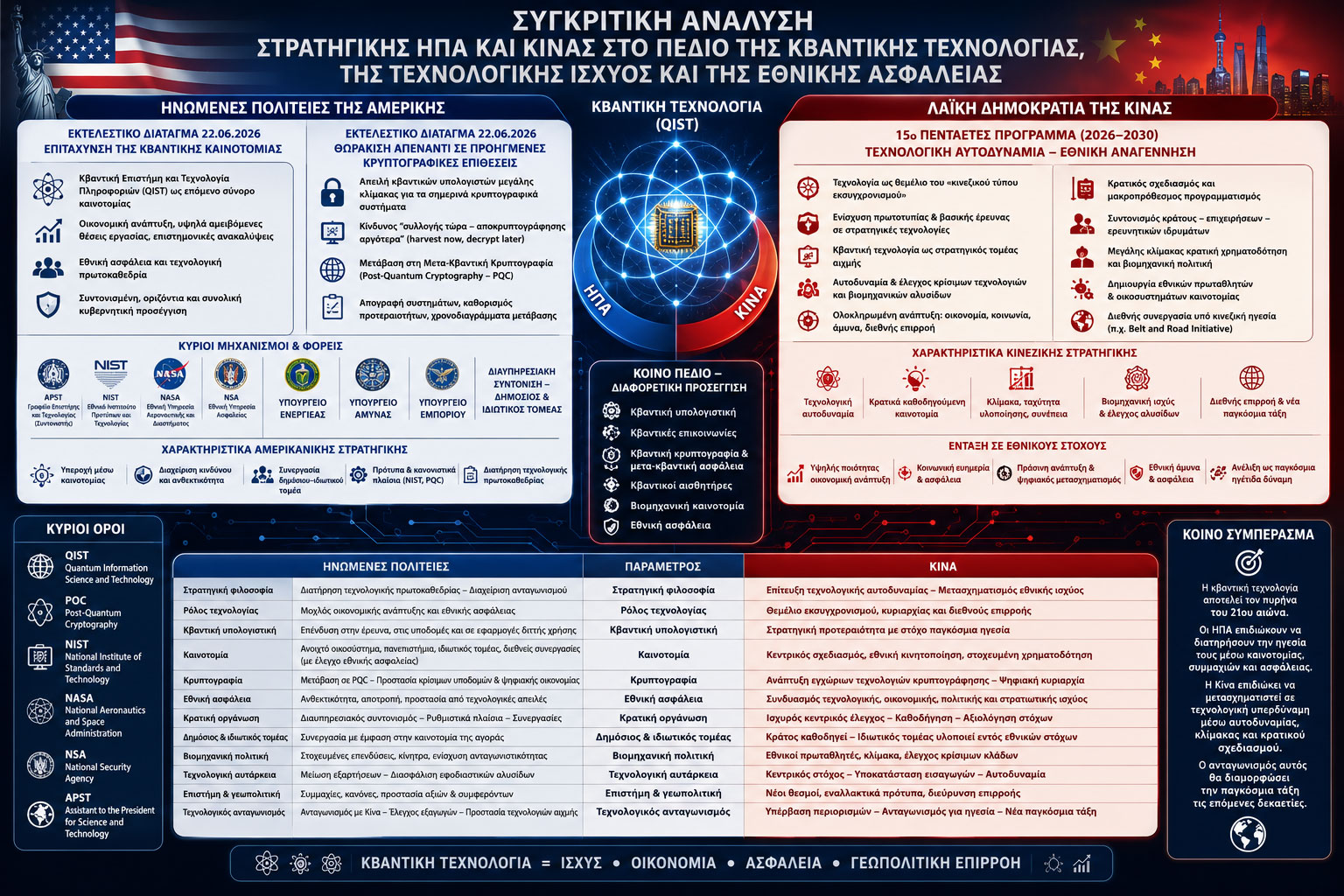
Click to enlarge image
Dialogue Excerpt:
Rania Gatou: Professor, before we begin examining the competition between the United States and China and their different strategies in the field of quantum technology and innovation, I would like to start with the most fundamental question, so that our discussion is understandable even to readers without specialized knowledge of physics. What are quantum technology and quantum innovation?
Kyriakos Kyriazopoulos: Quantum physics is the branch of physics that studies how matter and energy behave on an extremely small scale, primarily at the level of atoms, electrons, photons, and other subatomic particles.
Its fundamental peculiarity is that, at this microscopic scale, nature does not behave in the way we are familiar with from everyday experience. A car, a ball, or a person normally has a definite position and a definite state. In quantum physics, by contrast, a very small particle can be described as being in more than one possible state at the same time, until a measurement is made. This is known as quantum superposition.
A second fundamental phenomenon is quantum entanglement. Two quantum particles can become connected in such a way that their states are described jointly, even when they are separated by a large distance. This phenomenon is fundamental to several modern quantum technologies.
Click to view the full dialogue »
The dialogue is currently in Greek. Soon available in English.
Dialogues between Rania Gatou and Professor Kyriakos Kyriazopoulos on the book The Age of AI by Henry Kissinger, Eric Schmidt, and Daniel Huttenlocher
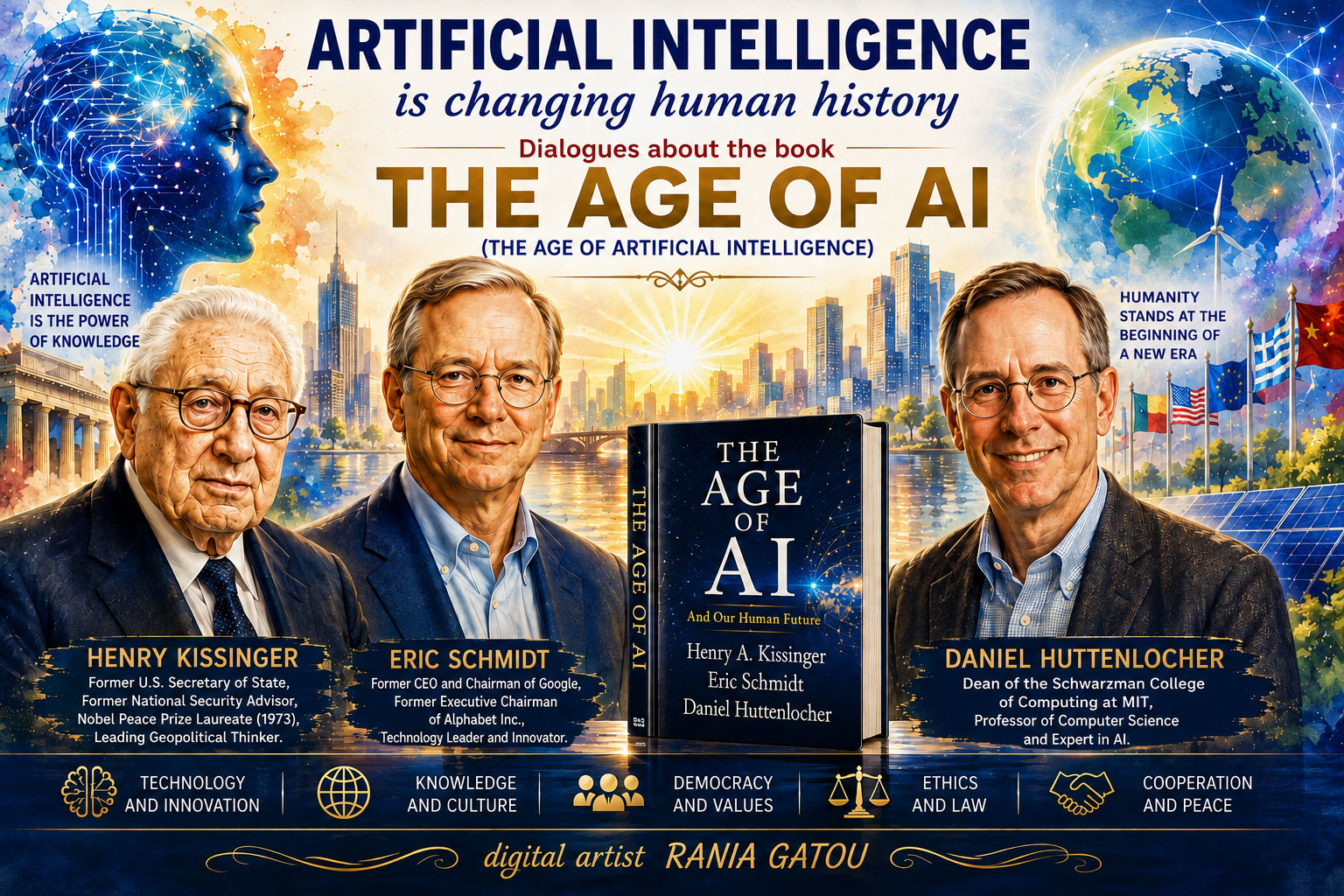
Click to enlarge image
Dialogue Excerpt:
Rania Gatou: Professor, The Age of AI by Henry Kissinger, Eric Schmidt, and Daniel Huttenlocher is already regarded as one of the most significant works on artificial intelligence. Before we examine its contents, I would like to ask you something fundamental. What led three individuals with such different backgrounds—a distinguished diplomat, a pioneer of digital technology, and an academic—to collaborate on writing this book?
Kyriakos Kyriazopoulos: The very composition of the authors reveals the purpose of the work. Henry Kissinger comes from the field of geopolitics and the history of international relations. Eric Schmidt represents Google's technological and entrepreneurial experience. Daniel Huttenlocher is an academic with profound expertise in computer science and artificial intelligence. Their message is already clear from the very first page: artificial intelligence is not an issue that concerns only engineers or programmers. It affects philosophy, politics, economics, law, science, and ultimately human existence itself. For this reason, an interdisciplinary approach is required.
Click to view the full dialogue »
The dialogue is currently in Greek. Soon available in English.
Dialogue between Rania Gatou and Kyriakos Kyriazopoulos on Yuval Noah Harari’s book 21 Lessons for the 21st Century
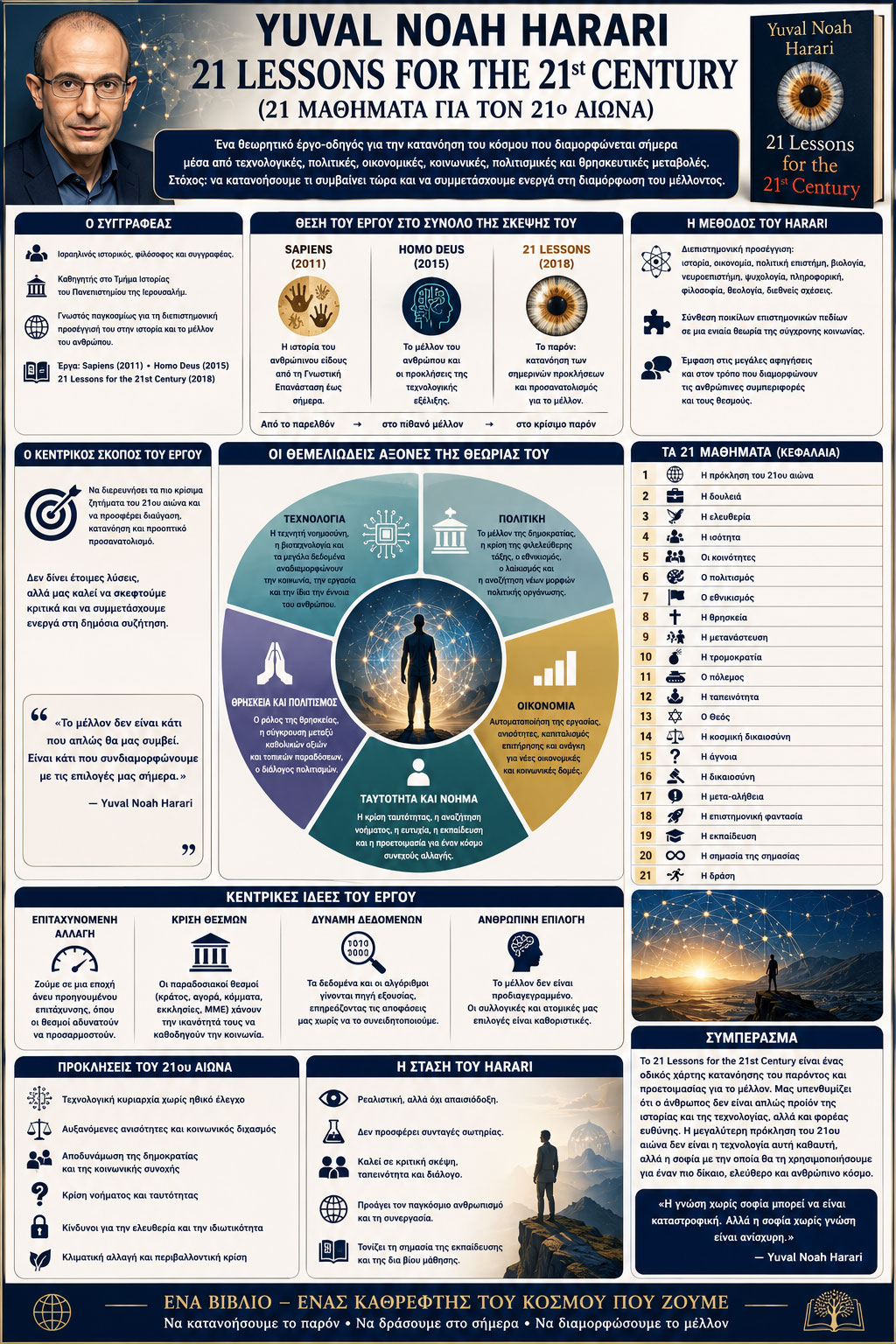
Click to enlarge image
Dialogue Excerpt:
Rania Gatou: Professor, I would like us to begin with the fundamental question. Why did this book generate such extensive international discussion?
Kyriakos Kyriazopoulos: Because Harari does not attempt to write yet another history of the past, nor a prediction of the distant future. He attempts to interpret the present. He argues that humanity is living through a period in which traditional political, social, and ideological certainties are weakening, while technological developments are accelerating at an unprecedented pace. According to the book’s introduction, the central question is how human beings can understand a world that they themselves have created but are increasingly finding difficult to control.
Rania Gatou: The first part of the book concerns the technological challenge. Why does Harari consider technology to be the most important issue of our time?
Kyriakos Kyriazopoulos: Because, in his view, for the first time in history the technologies of information science and biotechnology are not merely transforming humanity’s tools but humanity itself. Artificial intelligence, big data, and biotechnology may influence work, freedom, equality, and even the very concept of human personality. This constitutes the fundamental starting point of the book.
“Televised discussion on the Rotonta”
Ev Zin TV Programme (DION Television of Central Macedonia)
Watch the discussion on YouTube.