








TEACHING STAFF EVALUATION
Introduction
This report has been prepared within the framework of the internal evaluation and accreditation process of the Postgraduate Studies Programme (PSP), in accordance with the standards of the Hellenic Authority for Higher Education, conducted from 10 to 16 March 2026. It is based on the analysis of seven (7) anonymous questionnaires completed by teaching staff, reflecting their views on the operation, structure, teaching, and overall quality of the programme.
The objectives of the report are:
- to present the current state of the programme,
- to highlight good practices,
- to identify areas for improvement,
- to support the accreditation process.
Methodology
The analysis was conducted through:
- qualitative processing of open-ended responses,
- quantitative assessment of closed-ended questions,
- grouping of findings according to the evaluation criteria of the Hellenic Authority for Higher Education.
The sample (N=7) is considered adequate for drawing indicative conclusions, given the size of the PSP teaching staff.
Faculty Profile
Participants include:
- faculty members and external collaborators,
- instructors with varying levels of experience (from 1–2 years to over 5 years),
- teaching mainly in theoretical courses and supervising master’s theses.
Conclusion: The programme demonstrates a balanced mix of experience and renewal.
Academic Identity and Objectives
- Findings
- The objectives of the PSP are assessed as clear, coherent, and scientifically grounded.
- A strong interdisciplinary identity is recognized.
- A small number of instructors consider that interdisciplinarity could be further strengthened.
- Assessment
The programme has a clear academic orientation and an established identity.
Design and Structure of the Programme of Studies
- Findings
- The structure is evaluated as coherent and well-organized.
- The programme adequately covers the subject area (near-unanimous agreement).
- Suggestions include:
- differentiation in course weighting,
- greater flexibility in course selection.
- Assessment
The structure is effective, with room for improvement in terms of study personalization.
Teaching and Learning
- Teaching Methods
A combination of:
- lectures,
- interactive teaching,
- seminars,
- presentations and research assignments.
- Students
- Level: high to excellent
- Participation: active and substantial
- Collaboration: excellent
- Assessment
The learning environment is characterized by high quality and active participation.
Student Assessment
- Findings
- Methods:
- written assignments,
- presentations,
- oral examinations.
- Procedures:
- evaluated as clear and transparent.
- Assessment
The assessment system is reliable and aligned with the programme’s objectives.
Teaching Staff and Collaboration
- Findings
- High level of collaboration among instructors.
- Satisfactory coordination of courses.
- Assessment
There is strong academic cohesion and a collaborative environment.
Educational Resources and Infrastructure
- Findings
- Infrastructure: adequate
- Library and databases: very good access
- Digital platforms: effective
- Assessment
No significant deficiencies in resources or infrastructure are identified.
Administrative Support
- Findings
- Secretariat: satisfactory to very good
- Partial need for strengthening administrative staff
- Assessment
Administrative support is adequate, with room for improvement.
Link with Research and the Labour Market
- Findings
- Strong link with research
- Good but uneven connection with the labour market
- References to contemporary fields (e.g. Artificial Intelligence)
- Assessment
The programme is research-oriented, with potential to strengthen its professional dimension.
Continuous Improvement
- Findings
- High participation in evaluation processes
- Generally positive assessment of the use of results
- Assessment
An effective quality assurance mechanism is in place.
Internationalisation
- Findings
- Use of international bibliography
- Positive evaluation of international orientation
- Assessment
The PSP demonstrates a satisfactory level of internationalisation.
Remarks Regarding the Taught Seminars
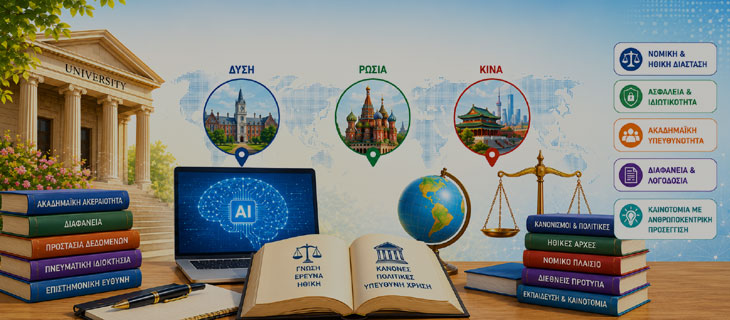
From the first semester of the current academic year (2026), following a proposal by the Director, the Coordinating Committee introduced the Seminar entitled “Artificial Intelligence, Ethics and Democracy,” which is taught on a rotating basis by instructors from all subject areas of the PSP, as well as by invited lecturers and specialists, in both the first and second semesters, with the prospect of being converted into a sixth elective compulsory course of the PSP once its accreditation by HAHE is completed.
In addition, from the first semester of the current academic year (2026), the Director introduced the Seminar entitled “Case Law of the European Court of Human Rights on Freedom of Religion and Other Human Rights Related to Religion or Belief,” which is taught in the first semester, and the Seminar entitled “Religious Human Rights and Relations between States and Religions or Belief Systems during the in situ Visits of the UN Special Rapporteur on Freedom of Religion,” which is taught in the second semester.
Overall Evaluation
- Strengths
- Clear academic identity
- High student quality
- High-quality teaching
- Coherent structure
- Strong faculty collaboration
- Adequate infrastructure
- Σημεία Βελτίωσης
- Strengthening interdisciplinary synergies
- Greater flexibility and differentiation of courses
- Enhancement of administrative support
- Stronger link with the labour market
Conclusions
The PSP "Theory of Law and Interdisciplinary Legal Studies" demonstrates a high level of quality and maturity, with a clear orientation and effective operation.
The proposed improvements are targeted and evolutionary in nature, indicating that the programme largely meets the accreditation criteria of the Hellenic Authority for Higher Education.
Action Plan Proposals
- Development of interdisciplinary courses/co-teaching
- Introduction of flexible course selection (tracks/specialisations)
- Strengthening links with professional bodies
- Gradual enhancement of administrative support
- Further internationalisation (collaborations, English-language components)
Thessaloniki, 27 March 2026
Director of the MSc Programme
Kyriakos Kyriazopoulos