








SWOT ANALYSIS
From Kyriakos Kyriazopoulos
Director of the postgraduate study programme
Preface
Quality assurance in higher education has evolved over recent decades from a process of periodic evaluation into a comprehensive system of strategic management, continuous improvement, and academic planning. The contemporary European concept of quality, as reflected in the Standards and Guidelines for Quality Assurance in the European Higher Education Area (ESG), is not confined to the recording of performance indicators or to formal compliance with institutional requirements. On the contrary, it regards every Postgraduate Study Programme as a dynamic academic organisation that is required continually to evaluate its identity, to reassess its strategic objectives, to analyse the external environment within which it operates, and to adapt its developmental course to evolving scientific, social, and professional needs.
Within this framework, SWOT analysis constitutes one of the most important instruments of strategic planning. Its value does not lie merely in the creation of four lists of strengths, weaknesses, opportunities, and threats. Its essential function consists in understanding the relationship between the internal and the external environment of an organisation, in revealing the strategic interactions between them, and, ultimately, in formulating well-founded policy proposals that enable long-term academic development.
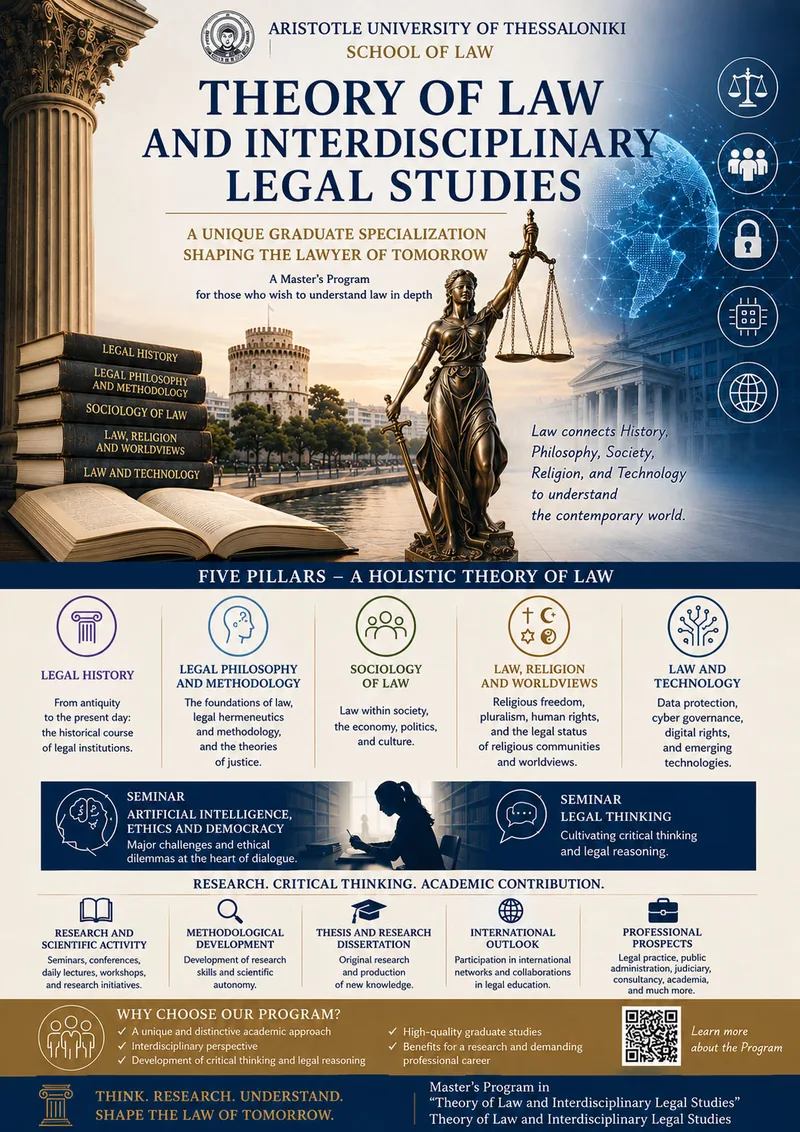
The present study applies precisely this methodological approach to the Postgraduate Study Programme “Theory of Law and Interdisciplinary Legal Studies” of the School of Law of the Aristotle University of Thessaloniki. It is a Programme with a distinctive academic identity, since it is not organised around an individual branch of positive law but constitutes a unified field of study combining the History of Law, the Philosophy and Methodology of Law, the Sociology of Law, Ecclesiastical Law, and Law and Informatics under the common academic umbrella of the Theory of Law and Interdisciplinary Legal Studies. This distinctive academic identity constitutes a fundamental characteristic of the Programme, as reflected in its current Operating Regulations, which determine the field of study, the objectives, the learning outcomes, the structure of the studies, and the overall strategy of the Postgraduate Study Programme.
The SWOT analysis that follows is therefore not confined to an administrative assessment of the operation of the Programme. On the contrary, it seeks to examine comprehensively its academic identity, its institutional organisation, the operation of its educational and research model, the effectiveness of its quality assurance procedures, and the prospects for its future development.
The study is based exclusively on primary documented material. First, the current Operating Regulations of the Programme are utilised, as approved by the decision of the Senate of the Aristotle University of Thessaloniki and published in the Government Gazette, which determine the institutional structure of the Postgraduate Study Programme, its objectives, its learning outcomes, the procedures for the selection of students, the structure of the programme of studies, and its operating procedures.
Second, the results of the internal evaluation of the teaching staff for the winter semester are used, providing particularly important data concerning the operation of the Programme from the perspective of the members of the teaching staff themselves. These evaluations highlight the quality of teaching, the cooperation among the teaching staff, the effectiveness of the administrative support, the degree of internationalisation, the connection between teaching and research, and the prospects for the further development of the Programme.
Third, the evaluations of the currently enrolled postgraduate students are utilised, reflecting the experience of daily participation in the Programme. These evaluations are of particular importance because they reveal the manner in which the students themselves perceive the structure of the Programme, the quality of teaching, the operation of the courses, the effectiveness of communication with the teaching staff, and the relationship between their studies and their professional and research needs.
Fourth, particular weight is attributed to the evaluations of the graduates. This source is particularly reliable because graduates are now in a position to compare the knowledge and skills they acquired during their postgraduate studies with the actual requirements of the labour market, academic research, and their professional development. Consequently, their views constitute a substantial indicator of the Programme's actual effectiveness.
Finally, the extensive study on the Programme's postgraduate specialisation by Kyriakos Kyriazopoulos is utilised, systematically analysing the epistemological foundation of the Theory of Law and Interdisciplinary Legal Studies and explaining why the distinctive combination of the five fields of study constitutes a unified and distinct form of postgraduate specialisation. This text does not merely constitute a descriptive presentation of the Postgraduate Study Programme, but a theoretical foundation of its academic identity, which is indispensable for the proper evaluation of its strategic characteristics.
The synthesis of all the above sources makes it possible to formulate a SWOT analysis that is based neither on subjective judgments nor on fragmentary impressions, but on documented data derived from the very institutional framework governing the operation of the Programme and from the organised internal evaluation procedures carried out within the framework of the accreditation of the Postgraduate Study Programme.
The present study therefore aspires to constitute not merely a descriptive SWOT analysis, but a comprehensive strategic assessment of the position of the Programme within the contemporary Greek and European environment of postgraduate legal studies. Through the systematic examination of its strong characteristics, its existing weaknesses, its emerging opportunities, and its potential external threats, an attempt will be made to formulate a comprehensive strategic picture of the Postgraduate Study Programme capable of supporting both its continuous improvement and its future academic development.
CHAPTER I
The Methodology of the SWOT Analysis and Its Application to the Evaluation of the Postgraduate Study Programme
The strategic evaluation of a Postgraduate Study Programme cannot be confined to the statistical processing of numerical indicators or to the simple presentation of positive and negative elements. The very concept of academic quality is multifactorial. It encompasses institutional, academic, educational, research, administrative, and social dimensions, which interact with one another and shape the overall identity of a postgraduate programme. For this reason, SWOT analysis is used internationally not as a method of merely recording data, but as an instrument for the strategic interpretation of the overall operation of an organisation.
Its application to the Postgraduate Study Programme “Theory of Law and Interdisciplinary Legal Studies” acquires even greater significance because it is a programme with a pronounced theoretical and interdisciplinary identity, which cannot be evaluated exclusively by quantitative indicators. Its academic identity, the composition of its fields of study, its research orientation, the quality of its academic dialogue, and the cultivation of critical legal thought constitute elements that require a comprehensive qualitative evaluation.
Accordingly, the SWOT analysis will be applied not as a static table of four categories, but as a comprehensive process of strategic assessment, in which each finding will be examined in the light of the institutional framework, the evaluations of the teaching staff, the currently enrolled students, the graduates, and the distinctive postgraduate specialisation provided by the Programme.
SWOT analysis is today one of the most widely established methods for the strategic assessment of organisations, institutions, and educational programmes. Its significance in higher education, however, does not consist merely in distinguishing between positive and negative elements. Its true function lies in its ability to capture the dynamic relationship between the internal characteristics of an academic organisation and the external environment within which it operates. In this way, SWOT is not merely a descriptive exercise in evaluation, but is transformed into an instrument of strategic planning, programming, and continuous improvement.
In the case of the Postgraduate Study Programme “Theory of Law and Interdisciplinary Legal Studies”, the need for such an analysis is even more evident. This particular Postgraduate Study Programme is not a typical postgraduate programme specialising in an individual branch of positive law. On the contrary, it constitutes a distinct academic field that seeks to connect the theory of law with the historical, philosophical-methodological, sociological, religious, and technological dimensions of legal science. Consequently, its evaluation cannot be carried out exclusively by means of indicators such as the number of publications, the duration of studies, or graduation rates. It must take into account the distinctive academic character of the Programme, its contribution to the development of theoretical legal thought, and its ability to create a coherent interdisciplinary learning environment.
The present SWOT analysis is based on a multi-level methodology. The first level concerns the institutional framework governing the operation of the Programme. The current Operating Regulations do not merely constitute an administrative document. They reflect the vision of the Programme, define its identity, determine the structure of the studies, describe the learning outcomes, establish the procedures for student selection, evaluation, the preparation of master's theses, and quality assurance. From this perspective, the Operating Regulations constitute the primary source for evaluating the design of the Postgraduate Study Programme itself.
The second level concerns the empirical evaluation of the operation of the Programme through its internal quality procedures. The evaluations of the teaching staff, the currently enrolled postgraduate students, and the graduates make it possible to ascertain the extent to which the institutional design is confirmed in practice. The value of these evaluations is not confined to the production of statistical averages. On the contrary, their true significance lies in identifying trends, recurring observations, and the points on which the different groups of evaluators converge. When, for example, the teaching staff, the students, and the graduates independently reach similar assessments regarding the quality of teaching, the organisation of the Programme, or its academic environment, these findings acquire particular credibility.
The third level of the methodology concerns the theoretical analysis of the postgraduate specialisation provided by the Postgraduate Study Programme. The evaluation of a postgraduate programme cannot disregard its epistemological subject matter. The quality of a programme devoted to the Theory of Law and Interdisciplinary Legal Studies cannot be assessed according to the same criteria as a programme specialising in commercial, civil, criminal, public, international, or European law. Its distinctive mission is the cultivation of theoretical thought, comparative analysis, philosophical and methodological foundation, pluralistic expression, historical interpretation, and interdisciplinary synthesis. Consequently, the SWOT analysis must examine the extent to which the operation of the Programme effectively serves this distinctive academic purpose.
The application of SWOT distinguishes four principal categories of factors. The Strengths constitute the internal characteristics of the Programme that confer upon it a comparative advantage. The Weaknesses concern internal elements that limit its effectiveness. The Opportunities refer to external developments that may be utilised for the benefit of the Programme, while the Threats include external factors that may adversely affect its future course.
The distinctive feature of the present study lies in the fact that these four categories will not be presented as independent lists. On the contrary, each element will be examined in relation to the others. A strength may create new opportunities. A weakness may reinforce the impact of an external threat. An external opportunity may be utilised only if the appropriate internal conditions exist. The strategic value of SWOT lies precisely in the study of these interactions.
Particular importance is attached, in the present case, to the distinction between the structural and the operational characteristics of the Programme. Structural characteristics are understood as those deriving from the design of the Postgraduate Study Programme itself, such as the duration of studies, the distribution of courses, the procedures for the selection of students, the composition of the Coordinating Committee, the procedure for the preparation of the master's thesis, and the organisation of quality assurance. Operational characteristics are understood as those relating to the manner in which the Operating Regulations are implemented in the day-to-day operation of the Programme, such as the quality of teaching, communication between the teaching staff and the students, the effectiveness of administrative support, the operation of digital services, and the participation of the academic community in academic activities.
This distinction is of particular importance for the SWOT analysis. A structural advantage, such as the originality of the Programme's identity, remains stable even where operational weaknesses exist. Likewise, an operational success, such as the particularly high level of student satisfaction with the quality of teaching, does not eliminate the need for the continuous revision of the Programme's structure in the light of new academic developments.
The methodology of the present study also places particular emphasis on the temporal dimension of evaluation. SWOT does not depict exclusively the present situation. It simultaneously examines the Programme's development over time and its future prospects. This element is crucial for a postgraduate programme operating within a highly dynamic academic environment, in which the internationalisation of higher education, the digitalisation of teaching, the development of artificial intelligence, the strengthening of interdisciplinary research, and the continuously increasing importance of the theoretical analysis of law are constantly transforming the requirements imposed upon postgraduate study programmes.
Accordingly, the strategic evaluation of the Postgraduate Study Programme is not confined to the assessment of the past. Its primary objective is to formulate a well-founded picture of its future. The identification of its strengths serves not only to record the Programme's achievements, but above all to utilise them as the foundation for its future development. Similarly, the identification of potential weaknesses is not intended as an exercise in criticism, but as a means of identifying the fields in which targeted improvement initiatives may be undertaken.
On the basis of the above methodology, the present SWOT analysis will proceed to examine the four principal axes of the strategic assessment of the Programme. The analysis will begin with the strengths of the Postgraduate Study Programme, which constitute the foundation of its academic identity and of its successful development to date.
CHAPTER II
The Strengths of the Programme: Its Distinctive Academic Identity as a Strategic Comparative Advantage
The most significant finding emerging from the study of the Operating Regulations, the evaluations, and the Programme's postgraduate specialisation is that the Programme's greatest comparative advantage does not lie in an individual organisational characteristic, but in the very conception of its academic identity.
The majority of Greek postgraduate programmes in law are organised around a specific branch of positive law. By contrast, the Postgraduate Study Programme “Theory of Law and Interdisciplinary Legal Studies” constitutes a unified field of study within which the History of Law, the Philosophy and Methodology of Law, the Sociology of Law, Ecclesiastical Law (or Law of Religion and Worldviews), and Law and Informatics function not as isolated specialisations but as mutually complementary manifestations of the same academic inquiry.
This choice endows the Programme with a unique academic identity, which distinguishes it substantially from most postgraduate programmes in legal studies in Greece.
This distinctive academic identity is not merely a theoretical choice reflected in the Operating Regulations, but is also confirmed by the actual operation of the Programme, as evidenced by the evaluations of the teaching staff, the currently enrolled postgraduate students, and the graduates. A comparison of these three sources reveals a remarkable convergence: all recognise that the Postgraduate Study Programme does not merely provide specialised knowledge but creates an environment of academic dialogue within which different theoretical approaches coexist in a creative manner.
This finding acquires particular significance when examined in the light of the contemporary development of legal science. The most important theoretical developments in contemporary law are no longer produced exclusively within the traditional branches of positive law. The philosophy of law, the history of institutions, legal anthropology, the sociology of law, bioethics, digital governance, and artificial intelligence now constitute a new academic environment in which interdisciplinarity is no longer a complementary characteristic but a fundamental prerequisite for the production of new knowledge.
This particular Postgraduate Study Programme appears to have adapted in a timely manner to this international academic transformation. Its postgraduate specialisation is not confined to the presentation of courses from different fields of study but is organised around a single theoretical axis: the understanding of law as a historical, philosophical, social, religious-cultural, and technological phenomenon. This choice constitutes perhaps the Programme's most important strategic advantage.
An equally important strength of the Postgraduate Study Programme is the internal coherence of its curriculum. In many postgraduate programmes, the existence of numerous fields of study ultimately results in the loose coexistence of independent courses. By contrast, in the present Programme there exists a common academic rationale that permeates all fields of study. The History of Law does not operate in isolation from the Philosophy of Law; the Sociology of Law interacts with Legal Methodology; Ecclesiastical Law (or Law of Religion and Worldviews) highlights the relationships between law, religion, and society; Law and Informatics examines the implications of digital technology through theoretical and normative approaches. This coherence creates a unified academic structure rather than a mere aggregation of courses.
Another particularly significant element, highlighted both by the Operating Regulations and by the evaluations, is the high quality of the teaching staff. The Postgraduate Study Programme is supported by faculty members with long-standing academic experience, significant scholarly output, and recognised standing within their respective fields. This composition makes it possible to cover an exceptionally broad spectrum of academic disciplines without sacrificing specialisation. The plurality of academic approaches does not lead to fragmentation but strengthens interdisciplinary dialogue.
Particular significance also attaches to the fact that the evaluations of the currently enrolled postgraduate students demonstrate a high level of satisfaction with the teaching competence of the faculty members. This finding acquires even greater weight because it is also confirmed by the evaluations of the graduates. The convergence of these two groups of evaluators indicates that the positive perception of teaching is not merely a temporary impression formed during the period of study but is maintained even after graduation, when graduates are able to compare their experience with other academic or professional environments.
The quality of teaching is directly connected with another important strength of the Programme: the emphasis placed on the development of academic thought rather than exclusively on the memorisation of knowledge. From the structure of the five (5) courses [History of Law, Philosophy and Methodology of Law, Sociology of Law, Ecclesiastical Law (or Law of Religion and Worldviews), and Law and Informatics], the two (2) seminars [1) Artificial Intelligence, Ethics and Democracy, and 2) Legal Thought], the academic activities organised at the initiative of the individual teaching staff together with the postgraduate students, and the master's theses, it is evident that the principal objective of the Postgraduate Study Programme is the cultivation of critical analysis, theoretical synthesis, and academic argumentation. This choice is fully consistent with the character of a programme devoted to the Theory of Law and Interdisciplinary Legal Studies.
A particularly important strategic advantage is also constituted by the organised process for the preparation of master's theses. A study of the Operating Regulations and of the catalogue of master's theses already completed demonstrates that the Postgraduate Study Programme has developed a particularly rich body of research output. The theses cover an exceptionally broad range of topics, from Roman and Byzantine legal history to the theory of interdisciplinary artificial intelligence, from the sociology of law to the legal protection of personal data, from the philosophy of law to law and religion or worldviews and bioethics. This diversity constitutes evidence of the actual operation of interdisciplinarity rather than merely its theoretical proclamation.
The analysis of the academic specialisations reveals yet another particularly significant strength of the Programme: its ability to incorporate new academic developments in a timely manner. The inclusion of subjects such as interdisciplinary artificial intelligence and digital law demonstrates that the Programme is not confined to traditional theoretical teaching but systematically follows developments in international scholarship.
At the same time, however, it maintains a strong presence in the classical fields of legal theory. The coexistence of Roman history, the Byzantine legal tradition, ancient Greek constitutional thought, the philosophy of law, legal methodology, freedom of religion and pluralism in a democratic society, the relations between states and religions or worldviews, and digital law creates a particularly rare academic ecosystem in which the old and the new are not regarded as competing with one another but operate in a complementary manner.
From an organisational perspective, another significant advantage is the clear regulatory organisation of the Programme. The current Operating Regulations display a high degree of completeness, clearly define the rights and obligations of all parties, provide detailed procedures for selection, evaluation, and the completion of studies, and incorporate all contemporary quality assurance requirements. The existence of such a comprehensive regulatory framework significantly limits the scope for administrative uncertainty and strengthens the transparency of the Programme's operation.
Another particular strength is the organised quality assurance policy. The Postgraduate Study Programme does not regard internal evaluation as a mere formal obligation towards the Hellenic Authority for Higher Education or the Quality Assurance Unit, but as a continuous mechanism for self-improvement. The systematic evaluation of courses, teaching staff, and graduates, the processing of the results, and their incorporation into strategic planning create a culture of continuous feedback, which constitutes a fundamental characteristic of modern European postgraduate programmes.
Another noteworthy advantage arises from the intensive academic activity accompanying the teaching process. The organisation of seminars, conferences, academic workshops, lectures, and thematic activities creates a broader academic environment in which postgraduate students are not confined to attending courses but participate actively in contemporary academic production.
The overall picture emerging from the foregoing is that the Programme's most important strengths are not fragmented. On the contrary, they constitute a coherent system of mutually reinforcing characteristics. Its strong academic identity is supported by highly qualified teaching staff. The quality of teaching strengthens the production of research. Research activity, in turn, nourishes academic specialisation. Academic specialisation, for its part, enhances the Programme's international recognition. Thus, a positive cycle of academic development is created, constituting perhaps the most important strategic asset of the Postgraduate Study Programme.
The existence of significant strengths, however, does not mean that the Programme is devoid of areas capable of further improvement. The strategic value of the SWOT analysis lies precisely in the fact that it examines the internal weaknesses with equal attention, not for the purpose of criticism, but in order to identify the fields in which its already particularly strong academic identity may be further strengthened.
CHAPTER III
The Weaknesses of the Programme: Internal Challenges and Areas for Further Strengthening
The identification of the weaknesses of a Postgraduate Study Programme should not be perceived as a negative evaluation of its overall operation. On the contrary, in the most mature quality assurance systems, the recognition of internal limitations constitutes evidence of institutional self-awareness and organisational maturity. A programme possessing a strong academic identity, a clear strategy, and effective evaluation mechanisms is required to identify honestly the areas in which it may be improved, so that its existing strengths may be transformed into even greater comparative advantages.
The examination of the Operating Regulations, the evaluations of the teaching staff, the currently enrolled postgraduate students and the graduates, together with the overall postgraduate specialisation, does not reveal any serious structural weaknesses of the Programme. On the contrary, it primarily discloses operational issues, which arise precisely as a consequence of the high academic aspirations of the Postgraduate Study Programme.
The first and most significant internal challenge is associated with its very multidisciplinary identity. The existence of five different academic directions constitutes, as already analysed, the Programme's greatest comparative advantage. At the same time, however, it creates increased demands with regard to the continuous coordination of the fields of study. Interdisciplinarity is not achieved automatically through the parallel teaching of different courses. It requires continuous theoretical synthesis, systematic cooperation among the teaching staff, and the constant renewal of the common academic axes linking the individual fields.
The broader the scope of academic specialisation becomes, the greater the risk that the individual fields of study may be perceived as relatively autonomous academic units. Although the evaluations do not indicate that this is currently the case, maintaining internal coherence constitutes a continuing strategic challenge and requires constant academic vigilance.
The second weakness is connected with the Programme's particularly high academic demands. The History of Law, the Philosophy and Methodology of Law, and the Sociology of Law presuppose highly developed skills of theoretical thought, interpretative analysis, and academic writing. The Programme is enriched by the fields of Ecclesiastical Law (or Law of Religion and Worldviews) and Law and Informatics, which constitute interdisciplinary applied branches of law and require both the specialised methodologies of the applied branches of law and, simultaneously, interdisciplinary methodologies.
This difficulty does not constitute evidence of a weakness in the academic design. On the contrary, it reflects the Programme's high academic level. Nevertheless, from a strategic perspective, it could be addressed even more effectively through more systematic introductory seminars on academic methodology, academic writing, and research techniques at the beginning of the studies, such as the available Seminar on Legal Thought.
Another aspect emerging from the evaluations concerns the exceptionally heavy workload required for the completion of the Programme. Continuous preparation, written assignments, participation in seminars, the preparation of the master's thesis, and engagement with extensive bibliography create a particularly demanding academic environment. This finding is positive in terms of the quality of the studies; at the same time, however, it highlights an operational difficulty for postgraduate students who are employed concurrently.
The current Operating Regulations address this issue to a significant extent through the possibility of part-time study. Nevertheless, the continuously increasing number of employed postgraduate students makes the constant re-examination of educational practices necessary, in order to maintain the high academic quality without creating disproportionate burdens.
Another internal challenge is related to the visibility of the Programme itself. The analysis of its postgraduate specialisation demonstrates that the Postgraduate Study Programme possesses exceptionally rich academic content, which, however, is not always immediately understood by prospective students who are unfamiliar with the identity of the Theory of Law and Interdisciplinary Legal Studies. The title of the Programme is exceptionally precise from an academic perspective; however, it requires a high degree of familiarity with theoretical legal studies and the interdisciplinary applied branches of law in order to be fully understood by a broader audience.
This observation acquires particular significance within the contemporary international academic environment, where postgraduate programmes compete not only in terms of quality but also in terms of the recognisability of their academic identity. The further international promotion of the Programme's distinctive character could constitute an area of strategic strengthening.
Another matter requiring continuous attention concerns the internationalisation of the Postgraduate Study Programme. The Programme possesses all the necessary prerequisites to develop an even stronger international presence. International scholarship, contemporary theoretical developments, interdisciplinary artificial intelligence, human rights, legal theory, interdisciplinary legal studies, and the comparative study of legal systems constitute fields of intense international interest. Consequently, the further expansion of courses taught in English, international collaborations, and the participation of international students could further strengthen the Programme's international standing.
An innovation of the Postgraduate Study Programmes is the teaching of the Seminar entitled “Artificial Intelligence, Ethics and Democracy,” which was introduced in the academic year 2025–2026 and constitutes an important factor in shaping the lawyer of tomorrow.
The evaluations of the graduates also highlight the importance of maintaining a closer and more systematic relationship between the Postgraduate Study Programme and its alumni network. The current situation is particularly positive; however, international best practices demonstrate that strong postgraduate programmes utilise their alumni network not merely as a mechanism of communication but also as an active component of their academic ecosystem. The systematic participation of graduates in academic events, the establishment of thematic alumni groups, the development of mentoring and student support programmes, and the continuous monitoring of their professional careers can further strengthen the Programme's outward orientation.
From an organisational perspective, the particularly extensive activities of the Postgraduate Study Programme also create increased demands for administrative support. The organisation of academic activities, the management of evaluations, student support, the updating of the website, international promotion, the organisation of conferences, compliance with quality assurance procedures, and continuous communication with stakeholders require considerable administrative work. As the Programme continues to develop, strengthening its administrative mechanisms constitutes a critical factor for maintaining the high quality of the services provided.
At the same time, the continuous incorporation of new academic subjects, such as interdisciplinary artificial intelligence and legal thought, creates the need for the periodic revision of the curriculum. The speed with which these fields evolve is much greater than the pace at which university curricula are normally revised. Consequently, the Postgraduate Study Programme must preserve the flexibility that already characterises it, so as to adapt the content of its courses in a timely manner to new academic developments.
Nevertheless, all the above observations share one common characteristic. They do not constitute structural weaknesses that diminish the quality of the Programme. Rather, they are primarily challenges arising from its very dynamic development. The more a postgraduate programme seeks to remain at the forefront of theoretical and interdisciplinary legal research, the greater become the demands for continuous renewal, coordination, and organisational support.
The overall assessment of the internal weaknesses therefore leads to a particularly important conclusion. The Postgraduate Study Programme “Theory of Law and Interdisciplinary Legal Studies” does not exhibit substantial academic or institutional weaknesses. The areas requiring further strengthening relate primarily to the next phase of its strategic development: the deepening of internationalisation, the further strengthening of its outward orientation, the development of its alumni network, adaptation to new technological developments, and the continuous support of the Programme's particularly high academic standards.
These findings naturally lead to the next stage of the SWOT analysis. Having examined the internal strengths and the internal challenges of the Postgraduate Study Programme, it is necessary to investigate the external environment within which it operates. Contemporary higher education is changing at an exceptionally rapid pace and is creating new opportunities for development for programmes possessing a strong theoretical and interdisciplinary identity. The analysis of these opportunities will demonstrate that the external environment currently presents more prospects than constraints for this particular Postgraduate Study Programme.
CHAPTER IV
Opportunities: The New International Academic Environment and the Strategic Development Prospects of the Programme
The evaluation of the external opportunities of a Postgraduate Study Programme is not confined to the identification of favourable circumstances. Their true strategic significance lies in the Programme's own ability to recognise them in a timely manner and to transform them into enduring elements of its academic development. An opportunity does not constitute an objective fact; it constitutes a potential that can be realised only when the Programme possesses the necessary internal prerequisites. Viewed from this perspective, the Postgraduate Study Programme “Theory of Law and Interdisciplinary Legal Studies” occupies a particularly favourable strategic position, because the most significant international developments in legal science coincide almost entirely with its identity and academic orientation..
The first and most significant opportunity concerns the profound transformation currently taking place in legal science at the international level. For many decades, legal education focused primarily on the systematic study of positive law. During the last two decades, however, the development of artificial intelligence, biotechnology, the digital economy, globalisation, the protection of human rights, the environmental crisis, and the transformation of democratic institutions have restored legal philosophy, legal methodology, legal history, legal sociology, religious pluralism, and digital law to the centre of international research. In other words, the international development of legal science itself is gradually moving towards the fields of study cultivated by this particular Postgraduate Study Programme and towards its interdisciplinary cooperation with other academic disciplines.
This development creates an exceptionally important prospect. A programme that already possesses a well-established theoretical identity does not need to alter its orientation in order to respond to new academic requirements. On the contrary, it occupies an advantageous position, since international academic developments are moving in the very direction that it has already adopted.
A particularly important opportunity also arises from the explosive development of artificial intelligence and digital governance. Legal science is now called upon to address unprecedented issues that cannot be resolved exclusively through traditional doctrinal methods. The interpretation of algorithmic decision-making, the liability of autonomous systems, the protection of personal data, algorithmic transparency, digital democracy, the ethics of artificial intelligence, and new forms of regulatory governance all require profound theoretical analysis. The fact that the Postgraduate Study Programme has already incorporated the relevant theoretical and interdisciplinary themes into both its teaching and its master's theses creates a particularly significant competitive advantage for the years ahead.
A comparable opportunity is presented by the gradual reassessment of the importance of legal history. European scholarship increasingly recognises that addressing contemporary institutional problems requires a deeper understanding of the historical evolution of legal institutions. The study of Roman law, the Byzantine legal order, the history of constitutional institutions, and the development of legal thought has once again acquired particular importance. The fact that these fields constitute essential components of the Programme's postgraduate specialisation creates significant opportunities for the development of international collaborations and research programmes.
Another particularly important opportunity is associated with the internationalisation of higher education. The ever-increasing mobility of students and faculty members, the development of joint postgraduate programmes, European university networks, and transnational research collaborations are creating a new academic environment within which programmes possessing a clear and distinctive academic identity become increasingly attractive. The present Postgraduate Study Programme possesses precisely this characteristic. It is not simply another programme of general legal studies, but a programme with a highly specialised academic profile, a fact that is capable of attracting both international students and visiting professors.
This opportunity is further strengthened by the international recognition of the Aristotle University of Thessaloniki. The University's participation in European networks, its collaborations with foreign universities, its involvement in international research programmes, and its increasing outward orientation create a favourable institutional environment within which the Postgraduate Study Programme may further expand its international collaborations.
A significant prospect for development also arises from the growing demand for specialised postgraduate studies extending beyond the boundaries of the traditional branches of law. The labour market, public institutions, independent authorities, international organisations, and research bodies increasingly seek professionals who possess not only knowledge of positive law but also the ability for theoretical analysis, interdisciplinary synthesis, and the understanding of complex social and technological developments. The identity of the Postgraduate Study Programme corresponds precisely to this new demand.
A particularly important opportunity is also created by the development of lifelong learning. An increasing proportion of prospective postgraduate students consists of practising lawyers, judges, attorneys, public officials, officials of independent authorities, and other professionals who wish to acquire theoretical depth beyond the everyday application of law. This particular Postgraduate Study Programme, precisely because of its theoretical and interdisciplinary identity, is capable of addressing this emerging educational need with particular effectiveness.
The analysis of the master's theses reveals another significant prospect. The research output already produced may constitute the foundation for the establishment of organised research groups, thematic laboratories, and academic networks devoted to specialised fields such as the theory of interdisciplinary artificial intelligence, the history of institutions, Ecclesiastical Law (or Law of Religion and Worldviews), the sociology of law, or the philosophy and methodology of law. In this way, the Postgraduate Study Programme may gradually develop not only into an educational institution but also into a research centre of reference in the corresponding fields.
A significant opportunity is also associated with the ever-increasing importance of quality assurance procedures in European higher education. The fact that the Postgraduate Study Programme already possesses an organised internal evaluation system, comprehensive Operating Regulations, a quality policy, clear procedures for the selection of staff, and systematic monitoring of its operation places it in a particularly favourable position in relation to the requirements emerging at the European level for the accreditation and international recognition of postgraduate programmes.
The increasing importance of postgraduate programmes taught in English also creates significant opportunities. The existing English-language presence on the Programme's website, the translation of its regulatory documents, the systematic development of English-language material, and the possibility of the gradual expansion of English-language teaching can make the Programme particularly attractive to international applicants, especially from the countries of South-Eastern Europe, the Eastern Mediterranean, and the wider Balkan region.
From a strategic perspective, the opportunity to utilise the alumni network is also of particular importance. As the number of graduates gradually increases, the conditions are created for the development of a strong academic community capable of functioning as a multiplier of the Programme's international presence and social influence. The active participation of graduates in academic activities, the establishment of an electronic alumni community, the organisation of annual alumni meetings, and the development of joint research initiatives can significantly strengthen the outward orientation of the Postgraduate Study Programme.
The overall picture emerging from the analysis of opportunities is particularly optimistic. It is rare to encounter a postgraduate programme in which the principal international academic developments coincide to such a great extent with its identity and strategic orientation. Theoretical legal thought, interdisciplinarity, interdisciplinary artificial intelligence, digital governance, the history of institutions, pluralism, multiculturalism, and the cultivation of complex analytical skills constitute precisely the fields upon which international legal scholarship is expected to focus during the coming decades.
This positive picture does not mean that the external environment is devoid of risks. Every period of intense academic transformation is accompanied by new challenges. The increasing competition among postgraduate programmes, the demographic decline of the student population, changes in the funding of higher education, the rapid pace of technological developments, and international mobility create a particularly demanding environment. The examination of these external risks constitutes the final stage of the present SWOT analysis and will make it possible to complete the overall strategic assessment of the Programme.
CHAPTER V
Threats: External Factors That May Influence the Future Development of the Programme
The final dimension of the SWOT analysis concerns the external factors that do not depend upon the will of the Programme itself but may directly or indirectly affect its future development. Unlike weaknesses, which constitute internal characteristics and may be addressed through organisational or academic interventions, threats originate from the broader environment of higher education, society, and academic research. The effective strategic management of a postgraduate programme cannot eliminate external threats; it can, however, anticipate them, mitigate their consequences, and adapt its planning in a timely manner.
The most significant external challenge concerns the continuously increasing competition among Postgraduate Study Programmes, both in Greece and internationally. During the last two decades, a continuous increase has been observed in the number of postgraduate programmes offered by Greek and foreign universities. This development creates a highly competitive environment with regard to attracting prospective students, achieving international recognition, and securing research funding.
This threat does not concern only the present Postgraduate Study Programme but Greek higher education as a whole. Nevertheless, the Programme's distinctive theoretical and interdisciplinary identity substantially limits its negative consequences, precisely because the Postgraduate Study Programme does not compete directly with a large number of similar programmes. As regards the identity of the Programme, it may be maintained that the Postgraduate Study Programme "Theory of Law and Interdisciplinary Legal Studies" of the Aristotle University of Thessaloniki is unique among the three Greek Schools of Law, because it brings together within a single postgraduate programme the fields of the History of Law, the Philosophy and Methodology of Law, the Sociology of Law, Ecclesiastical Law (or Law of Religion and Worldviews), and Law and Informatics, with a clear interdisciplinary orientation. Its distinctive academic identity therefore reduces this risk, although it does not eliminate it entirely. The continuous promotion of the uniqueness of its postgraduate specialisation remains a strategic necessity.
A second significant threat is associated with demographic developments. The gradual decline in the number of higher education graduates, combined with the general demographic contraction of the Greek population, is expected to affect all postgraduate programmes during the coming decade. This development may reduce the pool of prospective students and further intensify competition among universities.
Addressing this challenge cannot rely exclusively upon the Greek market. The internationalisation of the Programme, the attraction of international students, the development of courses taught in English, and the strengthening of its international visibility constitute strategic choices capable of substantially mitigating the effects of demographic change.
The rapid pace of technological developments is also of particular significance. The development of interdisciplinary artificial intelligence, large language models, algorithmic justice, and the automated production of knowledge is fundamentally transforming not only the subject matter of teaching but also the very methods of university education. The fact that the Postgraduate Study Programme has already incorporated relevant themes constitutes a significant advantage. Nevertheless, the pace of developments is so rapid that it requires the continuous revision of educational material, learning outcomes, and research priorities.
This challenge is not confined to the field of Law and Informatics. It affects the History of Law, the Philosophy and Methodology of Law, the Sociology of Law, as well as Ecclesiastical Law (or Law of Religion and Worldviews) and Law and Informatics, that is to say, the theory of law, the interdisciplinarity of law, legal methodology, the philosophy of justice, and the very concept of legal argumentation. Consequently, continuous academic renewal is no longer an option but a prerequisite for maintaining academic leadership.
Another external threat arises from the changing funding of higher education and research. Constraints on public resources, increasing requirements for external evaluation, and the need to secure competitive funding create an environment in which postgraduate programmes are required to operate with ever greater organisational efficiency. The ability to participate in European and international research programmes is becoming increasingly important for maintaining and developing academic activity.
A further external challenge is constituted by the continuously increasing demand for international rankings, measurable quality indicators, and quantitative evaluation criteria. This trend may produce adverse consequences for programmes with a pronounced theoretical orientation, since their genuine academic contribution is not always readily reflected in quantitative indicators. The History of Law, the Philosophy and Methodology of Law, and the Sociology of Law generate knowledge within a different temporal horizon and according to different criteria of influence from those applicable to more applied academic and interdisciplinary fields, such as Ecclesiastical Law and Law and Informatics.
The strategic response of the Postgraduate Study Programme to this challenge cannot consist in adapting itself to purely quantitative models of evaluation. On the contrary, it requires highlighting its distinctive contribution to theoretical and interdisciplinary legal studies through high-quality publications, international collaborations, and research excellence.
Another challenge concerns the maintenance of the balance between specialisation and interdisciplinarity. International scholarship is moving simultaneously in two apparently opposite directions: on the one hand, hyper-specialisation is increasing, while on the other hand interdisciplinary approaches are becoming increasingly developed. The Postgraduate Study Programme is therefore called upon to maintain the balance between these two tendencies, avoiding both the fragmentation of fields of study and an excessively general approach.
Particular attention must also be paid to changes in the institutional framework governing higher education. Frequent legislative amendments, new accreditation requirements, changes in the operation of postgraduate programmes, and evolving funding procedures require continuous institutional adaptation. The Programme's experience to date demonstrates a significant capacity for adaptation, a fact that substantially reduces the corresponding risk.
A particular threat might also arise from the tendency of certain universities to regard theoretical and interdisciplinary legal studies as secondary in comparison with the applied branches of law, and indeed with the natural sciences. This is a perception that occasionally appears internationally, particularly during periods of severe economic pressure, when the immediate connection between academic studies and the labour market is emphasised. However, international developments themselves in interdisciplinary artificial intelligence, bioethics, human rights, and democratic governance demonstrate that theoretical and interdisciplinary education has now become a fundamental prerequisite for addressing the most complex legal issues. Consequently, this particular threat is substantially offset by the international enhancement of the importance of the theory and interdisciplinarity of law.
The overall assessment of the external threats leads to a particularly interesting conclusion. Most of the risks faced by the Postgraduate Study Programme are common to European higher education as a whole and are not specific to the Programme itself. Moreover, several of the apparent threats simultaneously become opportunities. Interdisciplinary artificial intelligence, for example, constitutes a challenge, while at the same time creating new fields of research in which the Programme is already active. Increasing international competition strengthens the need for differentiation, which the Programme already possesses through its distinctive academic identity. The internationalisation of higher education increases competition, but at the same time creates new opportunities for collaboration and outward orientation.
It is precisely this distinctive feature that constitutes perhaps the most important conclusion of the present SWOT analysis. Despite the challenges it creates, the external environment appears overall to be more favourable than adverse for a postgraduate programme possessing this particular academic identity. Most international developments do not operate as obstacles but rather strengthen its strategic course..
The completion of the analysis of the Strengths, Weaknesses, Opportunities, and Threats now makes it possible to formulate the overall strategic assessment of the Programme. This assessment will not be confined to a summary of the preceding chapters, but will seek to determine the strategic position of the Postgraduate Study Programme within the contemporary European Higher Education Area and to establish the framework for its future directions of development.
CHAPTER VI
Overall Strategic Evaluation and Development Prospects of the Postgraduate Study Programme “Theory of Law and Interdisciplinary Legal Studies”
The completion of the present SWOT analysis now makes it possible to formulate an overall strategic evaluation of the Postgraduate Study Programme “Theory of Law and Interdisciplinary Legal Studies” of the School of Law of the Aristotle University of Thessaloniki. This evaluation does not constitute a mere recapitulation of the individual findings that preceded it. On the contrary, it seeks to synthesise the findings that emerged from the study of the Operating Regulations, the postgraduate specialisation, the evaluations during the winter semester of the teaching staff, the active postgraduate students and the graduates, in order to present fully the actual strategic position of the Programme.
The first and perhaps most important conclusion is that the Postgraduate Study Programme displays a high degree of internal coherence. This finding does not concern exclusively the quality of teaching, nor is it limited to the positive evaluation of the individual courses. On the contrary, it refers to the finding that all the fundamental elements of the Programme operate in a complementary manner and serve a common academic strategy. The Operating Regulations, the structure of the Programme, the objectives of the postgraduate specialisation, the organisation of the courses, the research activities, the academic seminars, the evaluation of the students and the operation of the supporting structures constitute a unified and coherent academic system.
This observation is of particular importance in the light of contemporary quality assurance standards. A postgraduate programme is no longer evaluated exclusively on the basis of the quality of its teaching staff or the number of their publications. It is evaluated primarily on the degree to which all the elements of its operation serve a clearly defined academic mission. In the case of this particular Postgraduate Study Programme, this mission appears entirely identifiable: the development of high-level theoretical and interdisciplinary legal thought.
Equally important is the finding that the evaluations of the three principal stakeholder groups—the teaching staff, the active postgraduate students and the graduates—do not present substantial divergences regarding the overall image of the Programme. On the contrary, they form a remarkable convergence of perceptions. The teaching staff highlight the academic quality and research identity of the Postgraduate Study Programme. The active postgraduate students evaluate particularly positively the teaching, the organisation and the academic communication with the teaching staff. The graduates, for their part, retrospectively confirm the value of the knowledge acquired and the contribution of the Programme to their academic and professional development.
This convergence constitutes a particularly strong indicator of quality. In several postgraduate programmes, differences are often observed between the perception of the teaching staff and the experience of the students or between the evaluations of active students and those of graduates. In the present case, on the contrary, the three groups form a common image, a fact that lends increased reliability to the conclusions of the evaluation.
The analysis also demonstrated that the greatest strategic added value of the Programme does not lie exclusively in the content of the individual courses but primarily in the unique combination of the academic fields that constitute it. The History of Law, the Philosophy and Methodology of Law, the Sociology of Law, Ecclesiastical Law (or Law of Religion or Worldviews), as well as Law and Informatics do not function as independent thematic units. On the contrary, they are interconnected through a unified theoretical and interdisciplinary approach to legal science.
This distinctive structure acquires even greater significance in the light of the postgraduate specialisation. The specialisation is not limited to in-depth study of individual fields of knowledge but seeks to develop researchers and legal scholars with advanced theoretical training, methodological competence and interdisciplinary analytical ability. These are characteristics that correspond to the contemporary needs of legal science, particularly during a period in which the traditional boundaries between academic disciplines are becoming increasingly permeable.
The present analysis also demonstrates that the Postgraduate Study Programme has succeeded in developing a particularly strong relationship between teaching and research. This relationship does not constitute a theoretical declaration but is reflected in the actual operation of the Programme. The participation of postgraduate students in academic activities, the preparation of research papers of high standards, the organisation of academic conferences, the operation of the Seminar on Artificial Intelligence, Ethics and Democracy from the winter semester of the current academic year onwards, the operation of the Seminar on Legal Thought from the spring semester of the current academic year onwards, the continuous production of academic publications and academic textbooks, the holding of student evening events, the organisation of faculty lectures, and participation in research networks constitute a unified academic environment within which research does not appear as an activity subsequent to teaching but as an organic element thereof.
At the same time, the operation of the Programme displays a high degree of compatibility with the Standards and Guidelines for Quality Assurance in the European Higher Education Area [Standards and Guidelines for Quality Assurance in the European Higher Education Area (ESG), Standards and Guidelines for Quality Assurance in the European Higher Education Area] (https://enqa.eu/wp-content/uploads/2015/11/ESG_2015.pdf). The clear setting of objectives, the student-centred approach, the transparent selection procedures, the periodic revision of the Programme, the continuous evaluation of the educational process, the utilisation of the evaluation results and the development of mechanisms for continuous improvement correspond to the fundamental principles of the contemporary European quality framework.
The strategic position of the Programme within the Greek academic environment is also of particular importance. The SWOT analysis demonstrated that the Postgraduate Study Programme possesses characteristics that make its direct replication by other programmes difficult. The distinctive combination of the fields of study, the long-standing experience of the teaching staff, the systematic research output, the close connection between theory and practice, as well as the continuous updating of the fields of study create a significant comparative advantage. This element acquires particular importance within an increasingly competitive environment of postgraduate studies.
On the other hand, the present analysis demonstrated that the limitations that arise do not concern the core of the academic operation of the Programme but derive primarily from external factors, such as the general funding of higher education, demographic developments, the increasing international mobility of students, the continuous changes in the institutional framework and the need for ever greater international outward orientation. These are factors that affect Greek universities as a whole and not exclusively this particular Postgraduate Study Programme.
Perhaps the most characteristic finding of the SWOT analysis is that the external developments themselves create more opportunities than risks for the Programme. The development of interdisciplinary artificial intelligence, the emergence of new forms of law, developments in bioethics, democratic governance, the digital protection of rights, the theory of law and interdisciplinary legal studies reinforce the importance of theoretical and interdisciplinary legal sciences. Consequently, the international academic environment appears to favour particularly the strategic direction of the Programme.
The overall image emerging from the present evaluation leads to the conclusion that the Postgraduate Study Programme “Theory of Law and Interdisciplinary Legal Studies” is at a stage of institutional and academic maturity. It possesses a clear identity, a coherent curriculum, a high level of teaching staff, positive evaluation results from all stakeholder groups, organised operation and significant prospects for further development. Its strategic potential exceeds its present dimensions and creates the conditions for even greater international recognition during the coming years.
In this light, the SWOT analysis does not merely conclude that the Programme operates effectively. It reaches the broader conclusion that the Postgraduate Study Programme possesses the necessary institutional, academic and organisational prerequisites to develop into one of the most important centres of theoretical and interdisciplinary legal studies in Greece and to strengthen further its presence within the European and international academic environment, while at the same time maintaining its character as a programme of high quality, pronounced research identity and continuous academic renewal.
On the basis of the criteria examined—the Operating Regulations of the Postgraduate Study Programme, the evaluations during the winter semester of the teaching staff, the active postgraduate students and the graduates, as well as the identity of the postgraduate specialisation—the overall strategic assessment of the Programme is clearly positive. The identified strengths significantly outweigh the weaknesses, the opportunities for development exceed the external threats, and the existing organisational and academic structure provides a strong basis for maintaining and further strengthening the quality of the Programme during the coming years.